In This Blog
Get tips, updates & exclusives—no spam


BLOGS
CPMS vs. Doing It Manually: What Running a Charging Network Really Takes
CPO
Featured

CPMS vs. Doing It Manually: What Running a Charging Network Really Takes
Running a few EV chargers can look pretty simple from the outside.
Install the chargers. Keep an eye on them. Track usage somewhere. Ask someone at the site to check if there's a problem.
And when you only have a couple of chargers, that might actually work.
But then you add another location.
More people start using your chargers. Someone needs a refund. A charger goes offline. You need to know how much energy was consumed last month. Another charger from a different manufacturer gets added to the network.
Suddenly, the spreadsheet is getting bigger, the WhatsApp group is getting busier, and managing chargers is becoming a job of its own.
That's usually when the need for a Charge Point Management System (CPMS) becomes clear.
So, what does a CPMS actually change? And how different is it from managing your charging network manually?
Let's break it down.
First, What Is a CPMS?
A Charge Point Management System, or CPMS, is the software layer that helps you operate and manage your EV chargers.
Think of it as the control centre for your charging network.
Your chargers do the actual charging. The CPMS helps you manage what happens around it.
Depending on your setup and the capabilities of the platform, charging management software can help you monitor chargers, manage charging sessions, configure tariffs, view operational data, identify charger issues and manage multiple chargers from one place.
The chargers and CPMS typically communicate using OCPP (Open Charge Point Protocol).
OCPP is an open communication standard used between EV chargers and charging management software. It allows information and commands to move between the charger and the backend system.
In simple terms:
The charger does the charging. The CPMS helps you run the charging network.
And that difference becomes much more important as your network grows.
What Does Running an EV Charging Network Actually Involve?
Installing chargers is one part of running a charging network.
Operating them every day is another.
You need to know whether chargers are working, understand who's using them, keep track of sessions, manage pricing, handle problems and understand how your network is performing.
Here's what those jobs can look like manually versus with charging management software.
1. Is My Charger Actually Working?
Let's start with one of the most basic questions.
You installed a charger at a location.
How do you know it's working right now?
Doing it manually
Someone has to check.
Maybe you call the person managing the site. Maybe security tells you there's a problem. Maybe your operations team visits the location.
Or, in the worst case, you only discover something is wrong when a driver reaches the charger and calls you.
That might be manageable when all your chargers are at one location.
But what happens when you have chargers across five, ten or fifty locations?
With a CPMS
Charging management software gives your team visibility into your chargers from a central platform.
Instead of calling individual locations to understand what's happening, your operations team can check charger status remotely.
That means less dependence on manual checks and better visibility across the charging network.
2. Who Is Charging and What's Happening During Each Session?
A charging session isn't just someone plugging a cable into a car.
For an operator, there is information around that session that matters.
When did it start?
When did it stop?
How much energy was consumed?
Was the session completed successfully?
Doing it manually
You might depend on meter readings, logbooks, individual reports or spreadsheets.
The bigger the network gets, the harder it becomes to maintain a clean record of every charging session.
And if a customer raises a question about a particular session, finding the right information can take time.
With a CPMS
The charging management system becomes the central place for session information.
Instead of piecing together records from different places, your team can view charging activity through the platform.
That makes it much easier to understand how your chargers are actually being used.
3. How Much Should People Pay to Charge?
If you're operating chargers commercially, pricing quickly becomes another thing you need to manage.
Maybe you have one tariff today.
Tomorrow, your business model could require something different.
Doing it manually
You may have to calculate charges using meter readings and maintain records separately.
Every additional charger, site or pricing structure adds another layer of manual work.
And the more manual calculations involved, the more time your team spends managing them.
With a CPMS
A charging management platform can help you configure and manage charging tariffs centrally, based on the functionality supported by your platform and charging setup.
Instead of treating pricing as a separate manual process for every charger, it becomes part of the system running your charging network.
4. What Happens When a Charger Stops Working?
This is where manual charger management can become especially frustrating.
Imagine this:
A driver reaches your charger.
They try to start charging.
Something isn't working.
They call the site operator.
The site operator calls your team.
Your team calls someone else.
Someone eventually needs to figure out what happened.
Doing it manually
The entire process starts after somebody notices the problem.
If the charger isn't being used frequently, an issue could potentially go unnoticed until someone tries to use it.
Troubleshooting can also mean coordinating between site teams, charger manufacturers and your operations team.
With a CPMS
Charging management software gives your team visibility into charger status and available fault information.
Depending on the charger, OCPP version and CPMS capabilities, some actions may also be performed remotely.
The important difference is visibility.
Instead of depending entirely on someone at the location telling you something has gone wrong, your team has a central system for understanding what is happening across the network.
And reducing the time between “something went wrong” and “we know something went wrong” can make a big difference operationally.
5. Which Chargers Are Actually Being Used?
You have ten chargers.
One gets used constantly.
Another barely sees a session.
Do you know why?
More importantly, do you even know which one is which?
Doing it manually
You can collect data from individual locations and maintain spreadsheets.
But getting a network-wide view means bringing all that information together.
The more chargers you have, the harder that becomes.
With a CPMS
Charging activity and operational data are available through one management platform.
That gives operators a clearer picture of how their charging infrastructure is being used.
Over time, that information can help answer important business questions.
Which locations see more charging activity?
When are chargers being used?
Which chargers are sitting idle?
How much energy is being dispensed?
Having reliable information makes those conversations much easier than relying on assumptions.
6. What Happens When You Add More Chargers?
Three chargers are one thing.
Thirty chargers are another.
Three hundred chargers are an entirely different operation.
Doing it manually
Every charger you add potentially means another charger to check, another set of sessions to track and another asset your team needs to manage.
Add multiple locations or charger manufacturers and the operational complexity can increase quickly.
At some point, scaling the network also starts meaning scaling the people and processes required to manage it.
With a CPMS
New compatible chargers can be onboarded and managed through the same charging management platform.
Instead of creating a new process every time your network grows, you're expanding an existing system.
That's one of the biggest reasons to think about charging management software before your network becomes difficult to manage.
Manual Charger Management vs. CPMS
Here's what the difference looks like in everyday operations:
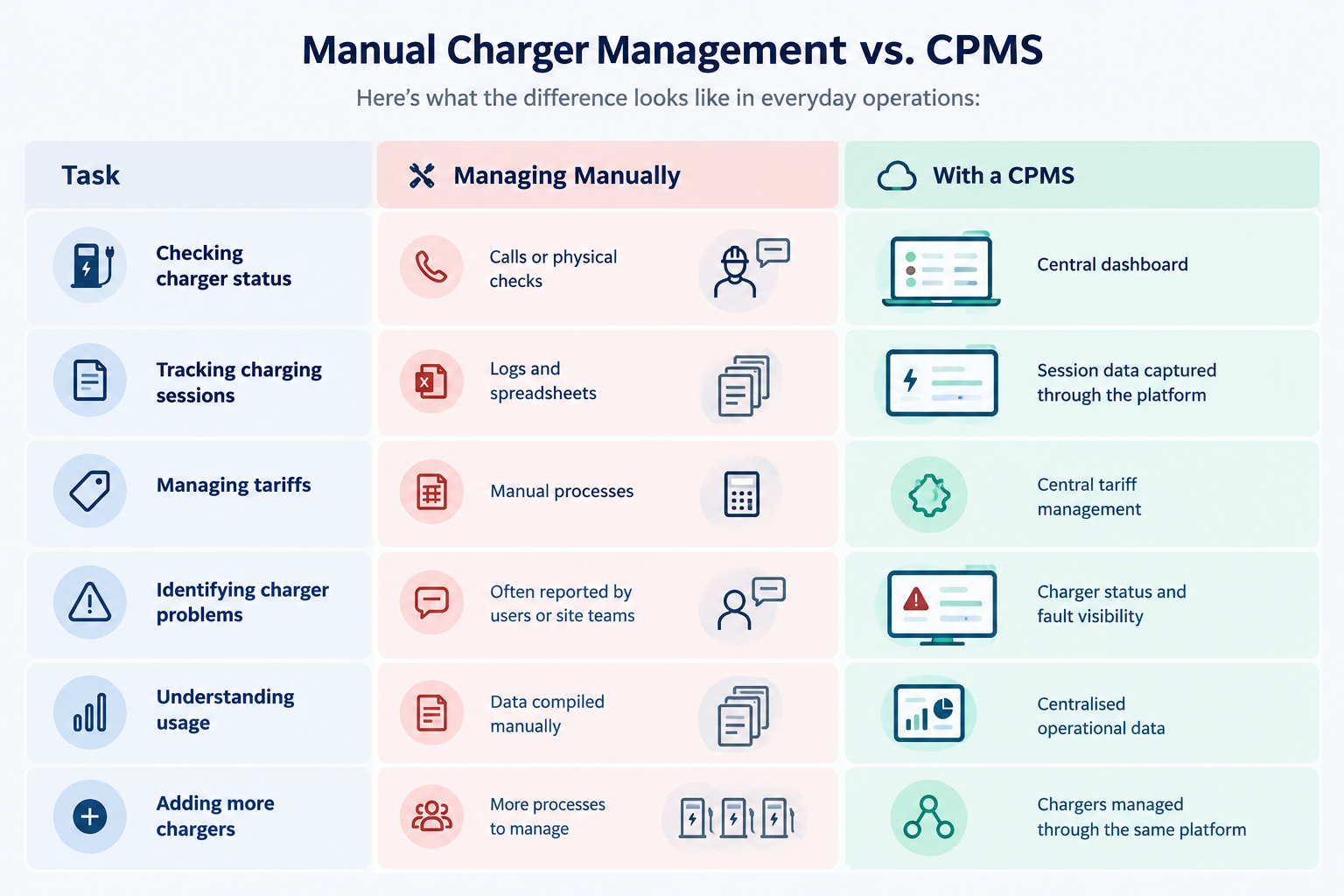
The important point isn't that manual management is impossible.
It isn't.
The question is how much manual work you want your team doing as your charging network grows.
When Does Manual Charger Management Stop Making Sense?
There's no magic number where you suddenly need a CPMS.
For a couple of chargers being used by a small and known group, a simple setup might be enough.
But the situation starts changing when:
- Your chargers are spread across multiple locations
- More people are using your charging infrastructure
- You're charging users for sessions
- You need reliable charging-session records
- Your team spends significant time checking charger status
- You need better visibility into charger issues
- You're adding chargers from different manufacturers
- You need to understand how your network is performing
- You're planning to scale your charging business
If several of these are starting to sound familiar, it's worth looking at a proper charging management system.
What Should You Look for in Charging Management Software?
Choosing a CPMS shouldn't only be about what you need today.
You should also think about what your charging network might look like a year or two from now.
OCPP Compatibility
If you're using or planning to use chargers from different manufacturers, OCPP compatibility is important.
It can help reduce dependence on a single hardware ecosystem and make it easier to manage compatible chargers through one software platform.
Centralised Charger Management
You shouldn't need a different operational process for every location.
Your CPMS should give your team a central place to manage your charging infrastructure.
Charger and Session Visibility
Your team should be able to understand what is happening across chargers and charging sessions without depending entirely on physical checks.
Tariff Management
If charging is part of your business, you need a practical way to manage the pricing applied to charging sessions.
Operational Data
Your charging software should give you useful information about how your infrastructure is being used.
Collecting data is one thing.
Being able to use it to operate the network is what matters.
Ability to Grow With Your Network
The platform you choose for your first few chargers shouldn't become the thing holding you back when you add more.
Think about multiple sites, different charger models, more users and a larger operations team from the beginning.
Where Does IONAGE Nexus Fit In?
This is exactly the operational problem IONAGE Nexus is designed to address.
IONAGE Nexus is a charging management platform for businesses and Charge Point Operators (CPOs) that want a central software layer for managing their EV charging infrastructure.
Instead of running charging operations through a combination of spreadsheets, site-level coordination and disconnected processes, Nexus brings charger management into one platform.
With IONAGE Nexus, businesses can bring compatible charging infrastructure onto a central management system and manage day-to-day charging operations as their network grows.
The idea is simple:
You focus on building your charging business. Your charging management software gives you the infrastructure to operate it.
Whether you're starting with a handful of chargers or building a larger charging network, putting the right software layer in place early can save a lot of operational complexity later.
The Charger Is Only Half the Setup
Buying and installing an EV charger feels like the big step.
But once it's live, another question begins:
How are you going to manage it?
For a small setup, manual processes might work.
But as chargers, locations, sessions and users increase, the work happening around those chargers increases too.
That's where a CPMS becomes more than another piece of software.
It becomes the operational layer connecting your charging infrastructure to the business you're trying to build.
And that's what IONAGE Nexus is built for.
Frequently Asked Questions
What is a CPMS in EV charging?
A Charge Point Management System (CPMS) is software used to manage EV charging infrastructure. It connects with compatible chargers and provides operators with a central system for monitoring chargers, managing charging sessions and handling other charging operations.
Can I manage EV chargers without a CPMS?
Yes. A small charging setup can be managed using manual processes. However, as you add more chargers, locations and users, tasks such as monitoring chargers, tracking sessions and managing operations can become increasingly difficult to handle manually.
What is the difference between a CPMS and an EV charger?
The EV charger is the physical hardware that delivers electricity to the vehicle. The CPMS is the software layer used to manage the charging infrastructure and the operational information around charging sessions.
What is OCPP?
OCPP (Open Charge Point Protocol) is an open communication standard that allows compatible EV chargers and charging management systems to communicate with each other.
Can chargers from different manufacturers be managed through one CPMS?
This depends on the chargers, their OCPP compatibility and the CPMS being used. One of the advantages of an OCPP-based charging management platform is the ability to support compatible charging hardware without tying operations entirely to a single charger manufacturer.
Do I need a CPMS if I only have a few chargers?
Not necessarily. A very small charging setup may be manageable manually. But if you plan to add more chargers, operate across locations, charge users or need better operational visibility, starting with a CPMS can make future expansion much easier.
Ready to Move Beyond Spreadsheets and Phone Calls?
Managing chargers shouldn't become harder every time you add another charger or location.
IONAGE Nexus gives CPOs and businesses a charging management platform designed to help them manage their charging infrastructure from one place.
Explore IONAGE Nexus and build a charging operation that's ready to grow.
As the world shifts gears toward a more sustainable future, the way we drive is changing—fast. Are you in the market for an EV? In your research, you might have come across different EV and Hybrid technologies from various manufacturers. Was it confusing or complex? We are here to de-mystify and help in your decision.
No worries—we’re here to break it down! Let’s explore the key differences between Electric Vehicles (EVs) and Hybrid Vehicles, so you can make the right choice.
What is the deal with electric vehicles (EV’s)
Electric vehicles run purely on electricity and are powered by rechargeable batteries that run the electric motor. That’s it. Here are a few reasons that give EVs an unfair advantage:
- Modern Design and Ownership: EVs have changed the fundamentals of the vehicle. You see a much more modern aesthetic and design for EVs. Additionally, this helps EV manufacturers develop innovative ways of ownership such as the MG Windsor.
- Lower Running Costs: The charge per kilometer for EVs is much lower than running on gas. Also, fewer running parts mean lesser maintenance.
- Eco-Friendly: With zero emissions, EVs are cleaner and quieter than traditional cars, contributing to reduced pollution and better air quality. Good for the planet, good for your lungs!
But it’s not all sunshine and supercharging. EVs do have some limits, especially when it comes to range. Currently, You’ll need to plan ahead if you’re going on a long road trip, but hey—that’s what apps and fast chargers are for! Then there is the question of batteries.

The Hybrid Vehicle: Best of Both Worlds?
If you're not ready to go fully electric yet, the next available option is a hybrid Vehicle. A hybrid vehicle uses a combination of gasoline and electric power to drive the vehicle. Hybrid technologies are considered a great intermediate step before the grand march toward a fully EV world. This makes them easy to recommend.
Here’s why a Hybrid Vehicle might be considered:
- Better Fuel Efficiency: Since hybrids can use electricity to supplement gasoline, they use less fuel overall—making them more efficient than traditional gas-powered cars.
- Extended Range: Worried about running out of charge? Hybrids still have gasoline backup, so you can go the distance without range anxiety.
- Familiarity: between EV and ICE, Hybrids feel like traditional fuel-powered cars but add a sustainable twist. It's just like an extension of an ICE.
Before pegging on the Hybrid Vehicle, consider the following.
- Space and Design: Hybrid Vehicles need to have batteries as well as a combustion engine. This greatly reduces space efficiency. Big boxes for the next adventure would be difficult to fit. They are also not as quiet as EVs. The design tends to be closer to traditional automotive without the advantages of the modern EV experience.
- Extended Range: Worried about running out of charge? Hybrids still have gasoline backup, so you can go the distance without range anxiety.
- Familiarity: between EV and ICE, Hybrids feel like traditional fuel-powered cars but add a sustainable twist. It's just like an extension of an ICE.
Still, for those who aren’t ready to take the full EV plunge, hybrids offer a solid first step.
Which One Should You Choose?
Ultimately, deciding between an EV and a Hybrid Vehicle comes down to your lifestyle and driving needs.
- If you’re all about cutting emissions and want the latest tech with the lowest environmental impact, go electric. You’ll be doing your part to keep the planet green while enjoying cutting-edge innovation.
- If you’re not ready to give up the flexibility of gasoline but still want to reduce your carbon footprint, a hybrid might be the perfect compromise.
At Ionage Technologies, we believe in the power of choice—because there’s no one-size-fits-all answer when it comes to sustainable driving. Whether you choose a full EV or a hybrid, both options represent a step toward a cleaner, smarter future.
Wrapping it up: the road ahead
As EV charging infrastructure grows and technology improves, the gap between electric and hybrid vehicles is closing fast. More people are embracing electric mobility, and the future looks bright. Whichever path you choose, it’s clear that sustainable mobility is the destination.
Ready to make your move? Join us on the journey to electrify the roads and drive toward a greener tomorrow.