In This Blog
Get tips, updates & exclusives—no spam


BLOGS
EV Charging App vs Google Maps: Which Is Better for Finding EV Chargers?
Ev Charging

EV Charging App vs Google Maps: Which Is Better for Finding EV Chargers?
You are driving with 20% battery left.
You search "EV charging stations near me" on Google Maps and find several options. Great. But then the real questions start.
Is the charger actually available?
What type of connector does it have?
How fast can it charge my EV?
Which charging network operates it?
Can I start the charging session from here?
Do I need another app to pay?
Finding a charging station is only the first step.
Google Maps is useful for finding places and navigating to them. But when it comes to the complete charging experience, a dedicated EV charging app can offer information and features built specifically for EV drivers.
So, which one should you use?
The answer isn't necessarily one or the other. It depends on what you're trying to do.
Can You Find EV Charging Stations on Google Maps?
Yes.
Google Maps can be useful for discovering EV charging stations near you or along your route. You can search for charging stations just like you would search for a restaurant, hotel, or petrol station.
It is particularly useful because most drivers are already familiar with the interface.
What Google Maps Does Well
- Find charging stations by location
- Provide navigation and directions
- Show locations along your route
- Display user reviews where available
- Help you explore nearby businesses and amenities
But there's an important distinction.
Google Maps helps you find a charging location. It isn't primarily designed to manage the charging experience itself.
That's where a dedicated EV charging app can offer more value.
What Does an EV Charging App Do Differently?
A dedicated EV charging app is designed around the specific needs of electric vehicle drivers.
Instead of simply showing you where a charger is located, it can bring together information and features that help you actually plan and manage your charging journey.
Depending on the platform and supported charging networks, this can include:
- Finding nearby EV chargers
- Checking charger availability
- Viewing charger and connector information
- Checking charging speeds
- Identifying charging networks
- Planning charging stops
- Starting charging sessions
- Making payments
- Tracking charging history
The difference can be summed up simply:
Google Maps helps you get to a charging station. An EV charging app helps you manage the charging journey.
Google Maps vs EV Charging App: What's the Difference?
Here's a quick comparison:
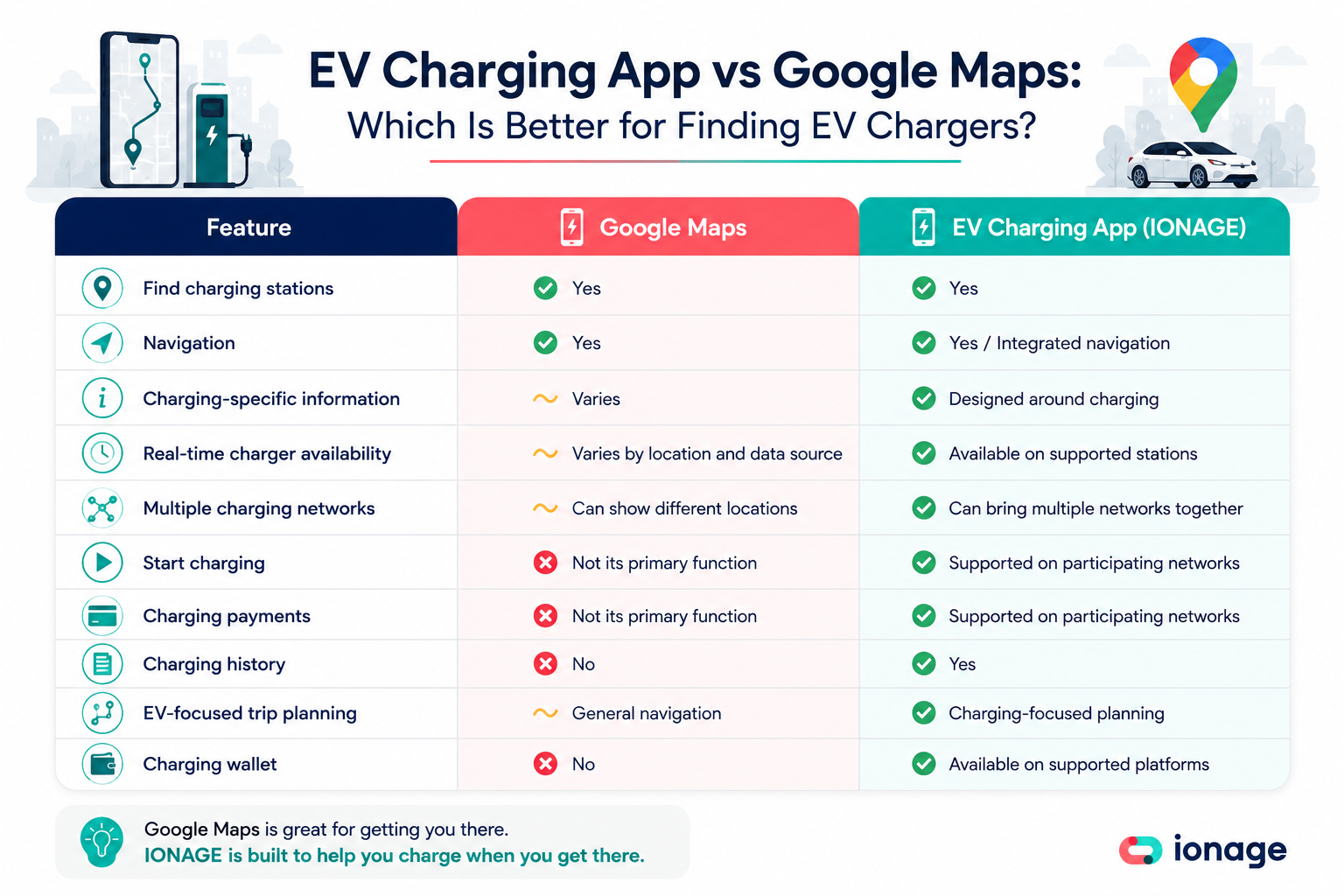
The point isn't that Google Maps is a bad tool.
It is an excellent navigation and location-discovery tool.
The question is whether you need general location information or charging-specific information.
1. Finding a Charger Is Different From Finding the Right Charger
Imagine you're travelling with 15% battery remaining.
You search for charging stations and find five nearby.
At first, that sounds like plenty of options.
But then you need to know:
- Which charger is compatible with your EV?
- What charging speed does it offer?
- Is it currently available?
- Which network operates it?
- How far is it from your current location?
- Can you use your preferred payment method?
- Do you need a separate app to start charging?
This is where the difference between a map and an EV charging platform becomes important.
The nearest charger isn't always the best charger.
The right charger is one that is compatible, available, accessible, and suitable for your journey.
2. Why Real-Time Charger Availability Matters
One of the biggest frustrations for EV drivers is reaching a charging station and discovering that the charger isn't available.
You may see that a charging station exists at a particular location, but that doesn't necessarily tell you whether you can charge immediately.
Real-time availability, where supported, gives you more useful information.
You can potentially:
- Avoid occupied chargers
- Reduce unnecessary detours
- Choose another station before arriving
- Plan your charging stop with greater confidence
Think about the difference between these two statements:
"There is an EV charger here."
and
"There is an available EV charger here."
For someone with a low battery, the second piece of information is much more useful.
3. Multiple Charging Networks Are Changing the EV Charging Experience
India's public charging ecosystem includes multiple charging networks.
That gives EV drivers more charging options, but it can also create a practical problem.
You may discover one charger on one network, another charger on a different network, and a third charger operated by another company.
If every network requires its own app, you can quickly end up managing:
- Multiple charging apps
- Multiple accounts
- Multiple wallets
- Different payment systems
- Different charging histories
Google Maps can help you discover charging locations from different operators, but finding a location and accessing the charging network are two different things.
This is one of the reasons multi-network EV charging apps are becoming increasingly useful.
4. Where IONAGE Fits In
IONAGE is built to make public EV charging simpler by bringing multiple charging networks together through one platform.
With access to 18,000+ charging points across 75+ charging networks, IONAGE gives EV drivers more charging options without requiring them to start their search on a different app for every network.
Through the IONAGE app, drivers can:
- Discover nearby EV charging stations
- Explore charging options across multiple networks
- Check real-time availability on supported stations
- Plan EV journeys
- Pay through one wallet for supported charging sessions
- Track charging history
So instead of starting with:
"Which charging network operates this station?"
you can start with:
"Where can I charge?"
That's a much simpler way to approach public EV charging.
5. Google Maps or an EV Charging App: When Should You Use Each?
The answer doesn't have to be either Google Maps or an EV charging app.
Both can have a role.
Use Google Maps When You Want To:
- Find a location
- Navigate to a destination
- Explore nearby businesses
- Check general location information
- Read reviews
- Get directions
Use an EV Charging App When You Want To:
- Specifically find EV charging stations
- View charging-specific information
- Check charger availability
- Plan charging stops
- Access multiple charging networks
- Start supported charging sessions
- Make charging payments
- Track charging history
The simplest way to think about it is:
Google Maps is built around getting you somewhere.
An EV charging app is built around helping you charge.
6. EV Charging Apps Can Be Especially Useful for Road Trips
For daily city driving, finding a charger nearby may be enough.
For a long-distance EV road trip, charging becomes part of the journey itself.
Suppose you're driving from Bengaluru to Chennai.
You don't just need to know that there are chargers somewhere along the route.
You need to think about:
Where should I stop?
Will the charger be suitable for my EV?
Is there another charging option nearby if my first choice isn't available?
Which networks are available along the route?
An EV charging app can help you approach these questions with charging-specific information.
Instead of waiting until your battery gets critically low, you can plan your charging stops ahead of time.
That can make long-distance EV travel more predictable and reduce the uncertainty that often contributes to range anxiety.
7. What Should You Look for in an EV Charging App?
Not every EV charging app offers the same experience.
If you're choosing an app, look for features that make charging easier before, during, and after your session.
Wide Network Coverage
An app that connects multiple charging networks can give you more charging options from one place.
Real-Time Availability
Knowing whether a charger is available can help you avoid unnecessary trips and waiting.
Accurate Charger Information
Connector type, charging speed, network information, and other relevant details can help you choose a suitable charger.
Trip Planning
If you regularly travel between cities, charging-focused route planning can make your journeys easier to manage.
Simple Payments
A convenient payment experience means less friction when you're ready to charge.
Charging History
Keeping your charging sessions and transactions in one place makes it easier to understand your charging activity and spending.
Simple User Experience
When you're low on battery, the last thing you need is a complicated app.
The best EV charging app is ultimately one that reduces friction rather than adding to it.
8. Is an EV Charging App Better Than Google Maps?
For general navigation and finding locations, Google Maps remains extremely useful.
For managing the charging experience, a dedicated EV charging app can be more useful because it is built around EV-specific needs.
So rather than asking:
"Which one should replace the other?"
A better question is:
"What am I trying to do?"
If you need directions to a location, Google Maps can do the job.
If you need to find a suitable charger, check its availability, plan a charging stop, make a supported payment, and keep track of your charging session, an EV charging app is designed for that purpose.
9. Can One EV Charging App Replace Every Other Charging App?
This is where it's important to be realistic.
Today, IONAGE is not the only EV charging app you may need.
There are charging networks that may not yet be available through IONAGE, depending on where you charge.
But the goal is to make that list smaller.
As more charging networks get added to IONAGE, EV drivers can access more charging options through the same platform.
Every new network integration means another charging option without necessarily requiring you to download and manage another app.
Our long-term vision is simple:
As more charging networks join IONAGE, we want to move towards a future where you need just one EV charging app to discover, charge, and pay across India's public charging ecosystem.
We're not there yet.
But every new network integration takes us one step closer.
10. The Future of Finding EV Chargers
The way EV drivers find chargers is likely to become increasingly connected.
Instead of thinking about individual charging networks, drivers will increasingly think about:
Where can I charge?
Is it available?
Is it compatible with my EV?
How far is it?
How do I pay?
The technology behind EV charging apps will continue to evolve around these questions.
For drivers, the ideal experience is simple:
Open one app, find the right charger, navigate there, charge, pay, and continue your journey.
That's the direction the industry is moving towards.
And that's the experience IONAGE is working to build.
Google Maps vs IONAGE: The Simple Answer
Google Maps and IONAGE serve different purposes.
Google Maps is a powerful tool for navigation and general location discovery.
IONAGE is built specifically around the EV charging journey, with access to multiple charging networks and charging-focused features.
You don't necessarily have to stop using Google Maps.
Instead, think of it this way:
Google Maps can help you get there.
IONAGE can help you charge when you get there.
And as more charging networks become available on IONAGE, the goal is to make that charging journey increasingly simple.
Conclusion
Finding an EV charger and managing your charging experience are two different things.
Google Maps can help you find locations and navigate to them. But when you need charging-specific information, real-time availability, access to multiple networks, charging payments, and charging history, a dedicated EV charging app can make the experience much simpler.
IONAGE brings 17,000+ charging points across 73+ charging networks together on one platform, helping EV drivers spend less time switching between apps and more time on the road.
IONAGE isn't claiming to be the only EV charging app you need today. There may still be charging networks that aren't available on IONAGE yet.
But as more charging networks get added, your list of charging apps can get shorter.
Today, IONAGE can reduce the number of apps you need. Tomorrow, our aim is to make one app enough.
Ready to simplify your EV charging journey?
Download the IONAGE App and discover 18,000+ charging points across 75+ charging networks.
Frequently Asked Questions
Can Google Maps find EV charging stations?
Yes. Google Maps can help users discover EV charging stations and navigate to them. However, the charging-specific information and functionality available can vary by location and data source.
Is Google Maps enough for EV charging?
Google Maps can be useful for finding charging locations and navigation. However, a dedicated EV charging app can provide additional charging-focused features such as network information, charger availability on supported stations, charging payments, charging history, and trip planning.
What is the difference between Google Maps and an EV charging app?
Google Maps is primarily a navigation and location-discovery platform. An EV charging app is designed specifically around the needs of EV drivers, including finding chargers, checking charging information, planning charging stops, and managing supported charging sessions.
Can an EV charging app show real-time charger availability?
Many EV charging apps provide real-time availability for supported charging stations. Availability and accuracy can depend on the charging network and the information it provides.
Which is better for EV road trips, Google Maps or an EV charging app?
Google Maps is useful for general navigation. An EV charging app can be more useful for planning charging stops because it is built around charging-specific information and, in some cases, multiple charging networks.
Can I use Google Maps and an EV charging app together?
Absolutely. You can use Google Maps for general navigation and an EV charging app for finding and managing your charging stops.
Is IONAGE the only EV charging app I need?
Not necessarily today. Some charging networks may not yet be available on IONAGE. However, as more charging networks are added, IONAGE aims to reduce the number of charging apps EV drivers need and move towards a future where one app is enough to discover, charge, and pay across India's public charging ecosystem.
As the world shifts gears toward a more sustainable future, the way we drive is changing—fast. Are you in the market for an EV? In your research, you might have come across different EV and Hybrid technologies from various manufacturers. Was it confusing or complex? We are here to de-mystify and help in your decision.
No worries—we’re here to break it down! Let’s explore the key differences between Electric Vehicles (EVs) and Hybrid Vehicles, so you can make the right choice.
What is the deal with electric vehicles (EV’s)
Electric vehicles run purely on electricity and are powered by rechargeable batteries that run the electric motor. That’s it. Here are a few reasons that give EVs an unfair advantage:
- Modern Design and Ownership: EVs have changed the fundamentals of the vehicle. You see a much more modern aesthetic and design for EVs. Additionally, this helps EV manufacturers develop innovative ways of ownership such as the MG Windsor.
- Lower Running Costs: The charge per kilometer for EVs is much lower than running on gas. Also, fewer running parts mean lesser maintenance.
- Eco-Friendly: With zero emissions, EVs are cleaner and quieter than traditional cars, contributing to reduced pollution and better air quality. Good for the planet, good for your lungs!
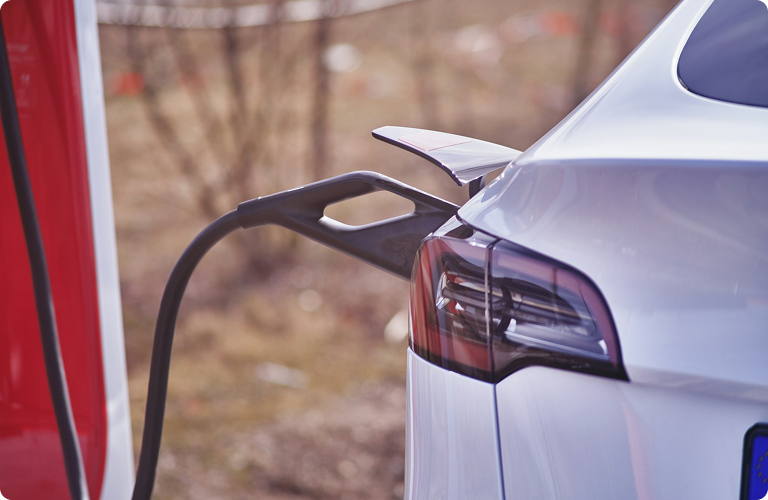
But it’s not all sunshine and supercharging. EVs do have some limits, especially when it comes to range. Currently, You’ll need to plan ahead if you’re going on a long road trip, but hey—that’s what apps and fast chargers are for! Then there is the question of batteries.
The Hybrid Vehicle: Best of Both Worlds?
If you're not ready to go fully electric yet, the next available option is a hybrid Vehicle. A hybrid vehicle uses a combination of gasoline and electric power to drive the vehicle. Hybrid technologies are considered a great intermediate step before the grand march toward a fully EV world. This makes them easy to recommend.
Here’s why a Hybrid Vehicle might be considered:
- Better Fuel Efficiency: Since hybrids can use electricity to supplement gasoline, they use less fuel overall—making them more efficient than traditional gas-powered cars.
- Extended Range: Worried about running out of charge? Hybrids still have gasoline backup, so you can go the distance without range anxiety.
- Familiarity: between EV and ICE, Hybrids feel like traditional fuel-powered cars but add a sustainable twist. It's just like an extension of an ICE.
Before pegging on the Hybrid Vehicle, consider the following.
- Space and Design: Hybrid Vehicles need to have batteries as well as a combustion engine. This greatly reduces space efficiency. Big boxes for the next adventure would be difficult to fit. They are also not as quiet as EVs. The design tends to be closer to traditional automotive without the advantages of the modern EV experience.
- Extended Range: Worried about running out of charge? Hybrids still have gasoline backup, so you can go the distance without range anxiety.
- Familiarity: between EV and ICE, Hybrids feel like traditional fuel-powered cars but add a sustainable twist. It's just like an extension of an ICE.
Still, for those who aren’t ready to take the full EV plunge, hybrids offer a solid first step.
Which One Should You Choose?
Ultimately, deciding between an EV and a Hybrid Vehicle comes down to your lifestyle and driving needs.
- If you’re all about cutting emissions and want the latest tech with the lowest environmental impact, go electric. You’ll be doing your part to keep the planet green while enjoying cutting-edge innovation.
- If you’re not ready to give up the flexibility of gasoline but still want to reduce your carbon footprint, a hybrid might be the perfect compromise.
At Ionage Technologies, we believe in the power of choice—because there’s no one-size-fits-all answer when it comes to sustainable driving. Whether you choose a full EV or a hybrid, both options represent a step toward a cleaner, smarter future.
Wrapping it up: the road ahead
As EV charging infrastructure grows and technology improves, the gap between electric and hybrid vehicles is closing fast. More people are embracing electric mobility, and the future looks bright. Whichever path you choose, it’s clear that sustainable mobility is the destination.
Ready to make your move? Join us on the journey to electrify the roads and drive toward a greener tomorrow.