In This Blog
Get tips, updates & exclusives—no spam


BLOGS
How Can CPOs Increase Revenue Without Installing More EV Chargers?
CPO

How Can CPOs Increase Revenue Without Installing More EV Chargers?
Before investing in another EV charger, ask a simpler question: Are your existing chargers serving as many drivers as they could?
A station might be missing charging sessions because a fault has not been resolved, a vehicle remains connected after charging, or drivers cannot easily find and access the charger. In these situations, adding more hardware is not necessarily the first problem to solve.
For Charge Point Operators (CPOs), the opportunity is to understand what is preventing existing stations from earning more, then address those issues.
Here are four areas worth examining, and how EV charging management software can support the work.
1. Reduce Failed Charging Sessions and Respond to Downtime Faster
Consider this situation: a driver reaches your station, connects their vehicle and tries to start charging. The session does not begin. After another attempt, they leave for a different station.
The immediate question is not whether you need another charger. It is why the available charger could not serve that customer.
Start by reviewing unsuccessful charging attempts alongside charger status, fault reports and customer complaints. Look for patterns rather than treating every complaint as an isolated incident.
Does the same connector repeatedly have problems? Do sessions stop unexpectedly at a particular site? How much time passes between an issue being reported and someone taking responsibility for it?
The aim is to move from responding to individual complaints to resolving recurring problems.
IONAGE Nexus provides visibility into charger uptime, utilisation, session activity and revenue, along with alerts for faults and downtime. These capabilities help operators identify which parts of their network need attention.
Remote visibility and diagnostics can also support troubleshooting before a team travels to the site. However, monitoring is not a substitute for maintenance. Physical damage or equipment faults may still require on-site repairs, so establish a clear escalation process with the responsible service team.
A useful starting point is to review the chargers with the most repeated issues and assign each one an owner, a corrective action and a follow-up date. Check whether charging performance improves after the action, rather than closing the issue simply because the charger appears online again.
2. Manage Vehicles That Stay Connected After Charging Ends
Imagine a charging session finishes at a busy station, but the vehicle stays plugged in while its owner continues shopping or having a meal.
The charger is no longer delivering energy to that vehicle, yet the connector remains occupied. Another driver arriving at the station may be unable to use it.
This is where parking fees can serve two purposes: encouraging drivers to release the charger and allowing the operator to charge for extended post-session occupancy. IONAGE Nexus supports this through its Parking Fee with Grace Period feature.
How the Grace Period Works
With IONAGE Nexus, CPOs can configure a grace period of 10–60 minutes after charging finishes. A configurable per-minute parking fee applies only if the vehicle remains connected beyond that period.
Operators control both settings through the Nexus dashboard. The parking fee does not apply while charging is in progress or during the grace period.
For example, suppose you set a 20-minute grace period. A driver disconnects 35 minutes after their charging session ends. The parking fee would apply to the additional 15 minutes, not the full 35 minutes.
Set the policy around the needs of the location, and explain it clearly before drivers begin charging. Signage at the station should reinforce the same information.
The objective should not be to surprise customers with another charge. It should be to give them a reasonable period to return while discouraging prolonged occupancy.
Also, keep the limitation in mind: releasing a connector creates an opportunity for another session only when another driver needs it. Parking fees cannot solve low demand, and an unplugged vehicle blocking a bay still needs on-site parking management.
3. Set Tariffs That Make Sense for Each Location
Increasing the price per unit is not the same as improving the performance of a charging station.
Before changing a tariff, examine what the site earns, what it costs to operate and how drivers currently use it. Electricity, maintenance and networking costs all contribute to the economics of a charging station, while utilisation affects the return from the infrastructure.
For each location, ask:
- What does it cost to deliver charging? Include electricity and applicable service, payment and operating costs.
- When is the charger being used? Compare busy and quiet periods rather than relying only on monthly totals.
- What do you actually earn per unit? Account for discounts instead of looking only at the published tariff.
A practical approach is to test a targeted change rather than revise prices across the whole network.
For instance, an offer during a quiet period could be worth testing where customers have flexibility over when they charge. But evaluate whether the additional energy sold makes up for the lower price. More sessions at a significantly reduced margin may not produce a better business result.
IONAGE Nexus supports tariff management alongside station and session operations, allowing CPOs to manage pricing within their charging management platform.
Treat pricing as something to measure, not something to guess. Record the starting point, make a defined change and compare the result over a suitable period. Avoid drawing conclusions from one unusually busy weekend or a short promotional spike.
4. Make Your Stations Easier to Find and Use
A charger can be working properly and still miss potential customers.
One question to investigate is whether drivers can discover the station, understand its charging options and successfully begin a session when they arrive.
Review your station from the driver’s point of view. Check the map location and entrance, opening hours, connector information, pricing and access instructions. Then walk through the process of reaching the charger and starting a session.
Do drivers arrive at the correct gate? Does the property team know that the charger is available to the public? Is it clear which app or payment method they can use?
These checks are particularly useful when a station is operational but has unexpectedly low usage.
Where the IONAGE App Fits In
While IONAGE Nexus supports charging-network operations, the IONAGE app serves the driver-facing experience. It helps EV owners discover charging stations, plan journeys and charge and pay at supported locations across connected networks.
For a CPO, this provides another way for drivers to discover and access supported stations beyond the operator’s own customer channels.
However, distinguish between being listed for discovery and being enabled for charging. When reviewing an integration, confirm which functions are available at your locations. A driver finding a charger on a map should not have to guess how to use it.
Think of discovery and access as one journey: finding the station is only useful if the driver can reach it and start charging.
What Could One Additional Charging Session Mean?
Consider a simple illustration.
Assume an existing charger serves one additional 20 kWh session per day, at a realised charging price of ₹18 per kWh, excluding taxes.
Over a 30-day month:
20 kWh × ₹18 × 30 days = ₹10,800 in additional charging revenue.
This is an illustrative calculation, not an IONAGE tariff or a revenue forecast.
It is also revenue, not profit. The electricity used and other applicable costs still need to be deducted.
The example shows why it is worth investigating missed sessions. Where demand exists, resolving a recurring fault, freeing an occupied connector or improving access could help an existing charger serve another customer.
The important question is not simply, “How many more sessions did we get?” It is, “Did the change create additional charging revenue at a sustainable cost?”
Measure Whether Your Changes Are Working
Before making changes, establish a baseline for each station. Then compare performance over similar periods.
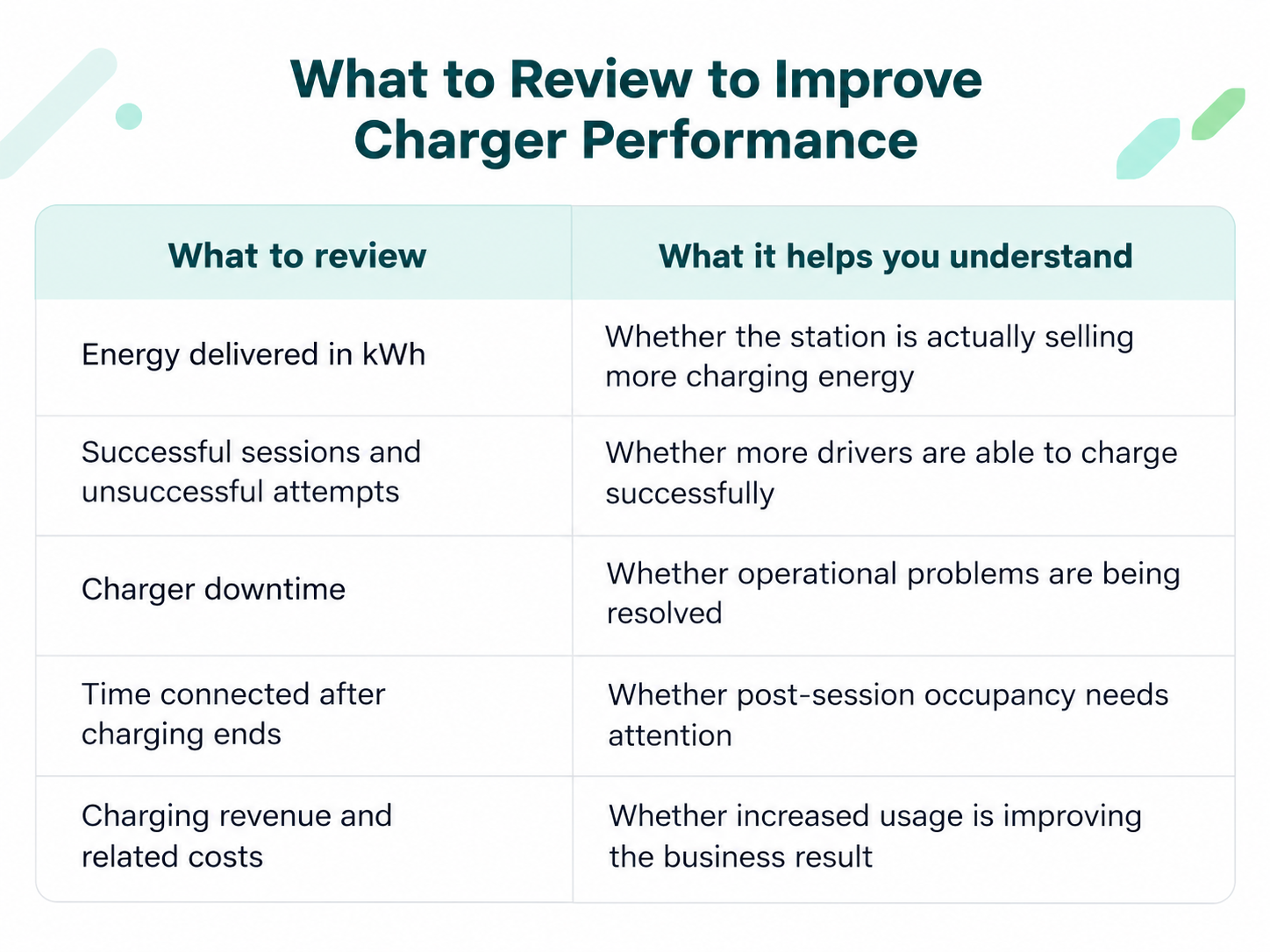
IONAGE Nexus’s monitoring and analytics capabilities cover uptime, utilisation, session data and revenue, providing visibility into key aspects of network performance. Use that information alongside your operating costs and site observations when deciding what to change next.
Start with a specific problem at a specific station. Fix it, measure the outcome and apply what works elsewhere. That is more useful than making several network-wide changes at once and not knowing which one made a difference.
Get More from the Charging Network You Have Already Built
Installing more chargers may be the right decision when demand exceeds your available capacity. But first, check whether the infrastructure you already have is being held back by avoidable operational issues.
Look at failed charging attempts. Review vehicles staying connected after sessions end. Examine pricing at each location. Make sure drivers can find and use your stations.
Growing a charging business is not only about adding more chargers. It is also about helping existing chargers serve more customers successfully.
Book a demo of IONAGE Nexus to explore how better visibility and control can support your charging operations.
Frequently Asked Questions
1. How can CPOs improve revenue from existing EV charging stations?
CPOs can focus on improving charger uptime, reducing failed sessions, managing post-charging occupancy, reviewing tariffs and improving charger discoverability. The goal is to help existing infrastructure serve more charging sessions before investing in additional hardware.
2. Why is charger utilisation important for CPOs?
Utilisation shows how effectively a charger is being used over time. A charger with low utilisation may be affected by factors such as poor visibility, repeated failures, inconvenient access or low demand. Monitoring utilisation alongside session and revenue data can help operators identify where improvements are needed.
3. What should CPOs monitor in an EV charging management system?
Key metrics include charger status, uptime, charging sessions, failed attempts, energy delivered, utilisation and revenue. Looking at these together gives operators a clearer picture of whether a station is operating reliably and contributing to the business.
4. How can CPOs reduce charger downtime?
Operators can reduce downtime by monitoring charger health, identifying recurring faults early and setting up a clear escalation process for technical issues. Remote visibility can help teams understand which chargers need attention, while hardware-related problems may still require on-site maintenance.
5. Can better charger management increase revenue without adding more chargers?
Yes, where sufficient charging demand already exists. Improving successful session rates, reducing avoidable downtime and making chargers available for the next user can create more opportunities for existing stations to serve customers. The impact should always be measured against operating costs and actual demand.
As the world shifts gears toward a more sustainable future, the way we drive is changing—fast. Are you in the market for an EV? In your research, you might have come across different EV and Hybrid technologies from various manufacturers. Was it confusing or complex? We are here to de-mystify and help in your decision.
No worries—we’re here to break it down! Let’s explore the key differences between Electric Vehicles (EVs) and Hybrid Vehicles, so you can make the right choice.
What is the deal with electric vehicles (EV’s)
Electric vehicles run purely on electricity and are powered by rechargeable batteries that run the electric motor. That’s it. Here are a few reasons that give EVs an unfair advantage:
- Modern Design and Ownership: EVs have changed the fundamentals of the vehicle. You see a much more modern aesthetic and design for EVs. Additionally, this helps EV manufacturers develop innovative ways of ownership such as the MG Windsor.
- Lower Running Costs: The charge per kilometer for EVs is much lower than running on gas. Also, fewer running parts mean lesser maintenance.
- Eco-Friendly: With zero emissions, EVs are cleaner and quieter than traditional cars, contributing to reduced pollution and better air quality. Good for the planet, good for your lungs!
But it’s not all sunshine and supercharging. EVs do have some limits, especially when it comes to range. Currently, You’ll need to plan ahead if you’re going on a long road trip, but hey—that’s what apps and fast chargers are for! Then there is the question of batteries.

The Hybrid Vehicle: Best of Both Worlds?
If you're not ready to go fully electric yet, the next available option is a hybrid Vehicle. A hybrid vehicle uses a combination of gasoline and electric power to drive the vehicle. Hybrid technologies are considered a great intermediate step before the grand march toward a fully EV world. This makes them easy to recommend.
Here’s why a Hybrid Vehicle might be considered:
- Better Fuel Efficiency: Since hybrids can use electricity to supplement gasoline, they use less fuel overall—making them more efficient than traditional gas-powered cars.
- Extended Range: Worried about running out of charge? Hybrids still have gasoline backup, so you can go the distance without range anxiety.
- Familiarity: between EV and ICE, Hybrids feel like traditional fuel-powered cars but add a sustainable twist. It's just like an extension of an ICE.
Before pegging on the Hybrid Vehicle, consider the following.
- Space and Design: Hybrid Vehicles need to have batteries as well as a combustion engine. This greatly reduces space efficiency. Big boxes for the next adventure would be difficult to fit. They are also not as quiet as EVs. The design tends to be closer to traditional automotive without the advantages of the modern EV experience.
- Extended Range: Worried about running out of charge? Hybrids still have gasoline backup, so you can go the distance without range anxiety.
- Familiarity: between EV and ICE, Hybrids feel like traditional fuel-powered cars but add a sustainable twist. It's just like an extension of an ICE.
Still, for those who aren’t ready to take the full EV plunge, hybrids offer a solid first step.
Which One Should You Choose?
Ultimately, deciding between an EV and a Hybrid Vehicle comes down to your lifestyle and driving needs.
- If you’re all about cutting emissions and want the latest tech with the lowest environmental impact, go electric. You’ll be doing your part to keep the planet green while enjoying cutting-edge innovation.
- If you’re not ready to give up the flexibility of gasoline but still want to reduce your carbon footprint, a hybrid might be the perfect compromise.
At Ionage Technologies, we believe in the power of choice—because there’s no one-size-fits-all answer when it comes to sustainable driving. Whether you choose a full EV or a hybrid, both options represent a step toward a cleaner, smarter future.
Wrapping it up: the road ahead
As EV charging infrastructure grows and technology improves, the gap between electric and hybrid vehicles is closing fast. More people are embracing electric mobility, and the future looks bright. Whichever path you choose, it’s clear that sustainable mobility is the destination.
Ready to make your move? Join us on the journey to electrify the roads and drive toward a greener tomorrow.