In This Blog
Get tips, updates & exclusives—no spam


BLOGS
EV Charger ROI Calculator: How to Calculate EV Charging Profitability Before Installing a Charger (2026 Guide)
CPO
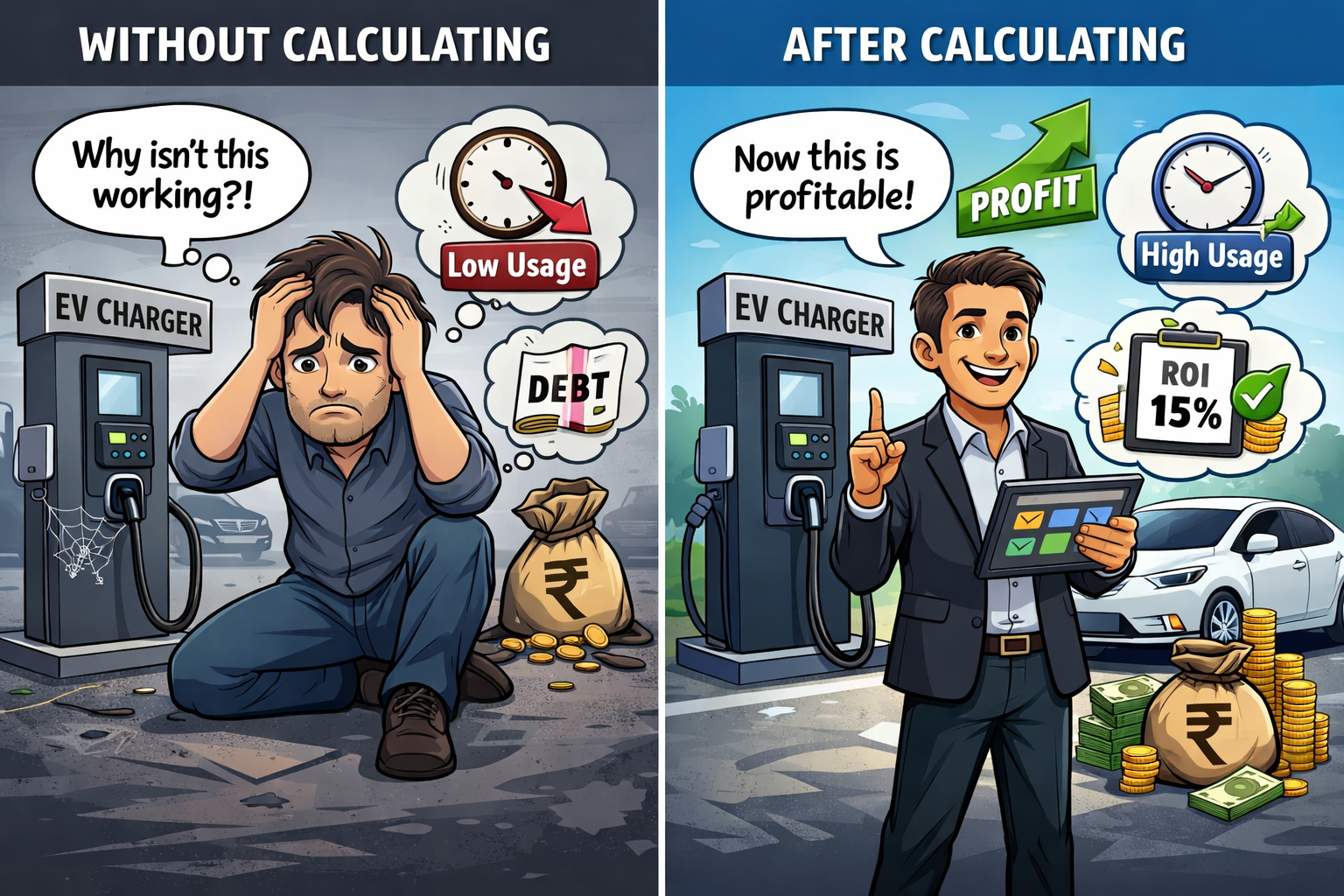
EV Charger ROI Calculator: How to Calculate EV Charging Profitability Before Installing a Charger (2026 Guide)
EV adoption in India is accelerating in 2026. Public charging infrastructure is expanding rapidly. Investments in EV charging stations are increasing across highways, commercial spaces, fleets, and residential hubs.
But before installing an EV charger, the most important question is:
Will it be profitable?
Installing a charger without calculating ROI is no longer a smart strategy. In today’s competitive EV market, financial clarity determines long-term success.
This guide explains how to calculate EV charger ROI, what factors affect profitability, and how the IONAGE Nexus ROI Calculator helps you make data-driven investment decisions.
What Is EV Charger ROI?
EV Charger ROI (Return on Investment) is the annual percentage return you generate from your EV charging infrastructure investment.
It helps answer:
- How much revenue will my charger generate per year?
- How many units (kWh) must I sell to stay profitable?
- How many hours per day must the charger run?
- How long will it take to recover my investment?
Without these numbers, you are investing based on assumptions, not strategy.
How to Calculate EV Charging Profitability
EV charging profitability depends on five core variables:
1. Charger Capacity (kW)
Higher capacity chargers (like 60 kW DC fast chargers) can deliver more energy per hour, increasing revenue potential.
2. Utilization Rate
The number of hours per day your charger is actively used.
3. Profit Margin Per Unit (₹/kWh)
Your margin after electricity costs, operational expenses, and platform fees.
4. Total Investment Cost
Includes hardware, installation, civil work, transformer upgrades, and setup.
5. Target ROI (%)
The annual return you expect from your capital investment.
When these variables are calculated correctly, profitability becomes predictable, not speculative.
Example: ROI for a 60 kW DC Fast Charger
Let’s look at an example.
.png)
Charger Type: DC
Capacity: 60 kW
Profit Margin: ₹12 per kWh
Target ROI: 12%
Projected results:

- Projected Annual Revenue Potential: ₹3,77,600
- Required Daily Utilization: 1.44 hours per day
- Units to Be Sold Annually: 31,467 kWh
- Estimated Investment: ₹11,80,000
- Annual Depreciation (20%): ₹2,36,000
This shows that even moderate daily utilization can generate stable double-digit returns when margins are optimized.
Why ROI Calculation Is Critical in 2026
The EV charging market is evolving fast:
- More CPOs are entering the ecosystem
- Utilization varies heavily by location
- Pricing competition is increasing
- Capital investment remains significant
Installing a charger without ROI modeling can lead to:
- Underutilized assets
- Delayed payback periods
- Cash flow pressure
- Lower-than-expected returns
Smart operators calculate first, deploy second.
What Is an EV Charging ROI Calculator?
An EV Charging ROI Calculator is a digital tool that estimates:
- Annual revenue potential
- Required daily utilization
- Total units to be sold
- Return percentage
- Depreciation impact
- Investment recovery expectations
Instead of building complex spreadsheets, you get instant financial projections tailored to your inputs.
How the IONAGE Nexus ROI Calculator Helps
The IONAGE Nexus ROI Calculator provides a complete profitability snapshot with just three inputs:
- Charger capacity
- Profit margin per unit
- Target ROI
It instantly calculates:
- Projected annual revenue
- Estimated ROI
- Required daily utilization
- Units needed to hit revenue targets
- Investment and depreciation breakdown
This enables:
- Charge Point Operators (CPOs)
- Parking space owners
- Fleet operators
- Real estate developers
- Corporate campuses
to make financially sound infrastructure decisions backed by data.
Frequently Asked Questions
How many hours per day should a 60 kW charger run to be profitable?
In many cases, 1.5-2 hours of daily utilization can generate a 10-15% ROI, depending on electricity costs and pricing strategy.
What is a good ROI for EV charging infrastructure?
A 10-15% annual ROI is considered healthy in the current Indian EV charging market, depending on utilization and operational efficiency.
How long does it take to recover EV charger investment?
Most financial models assume a 5-year charger lifespan. Payback period depends on utilization rates and profit margin per kWh.
Is EV charging profitable in India in 2026?
Yes, when utilization, pricing, and network visibility are optimized. Profitability is driven by data-backed decisions, not just installation.
From Installation to Optimization
Calculating ROI is the first step.
Maximizing it requires:
- Increasing charger visibility
- Improving daily utilization
- Smart pricing strategy
- Multi-network access
- Seamless payments
- Efficient charger management software
Data-driven operators consistently outperform assumption-driven operators.
Ready to Calculate Your EV Charger ROI?
Before installing your next charger, understand your numbers.
Know your revenue potential.
Define your required utilization.
Plan your investment with clarity.
👉 Try the IONAGE Nexus ROI Calculator now.
Because in 2026, EV charging isn’t just infrastructure.
It’s a business.
And profitable businesses start with numbers.
As the world shifts gears toward a more sustainable future, the way we drive is changing—fast. Are you in the market for an EV? In your research, you might have come across different EV and Hybrid technologies from various manufacturers. Was it confusing or complex? We are here to de-mystify and help in your decision.
No worries—we’re here to break it down! Let’s explore the key differences between Electric Vehicles (EVs) and Hybrid Vehicles, so you can make the right choice.
What is the deal with electric vehicles (EV’s)
Electric vehicles run purely on electricity and are powered by rechargeable batteries that run the electric motor. That’s it. Here are a few reasons that give EVs an unfair advantage:
- Modern Design and Ownership: EVs have changed the fundamentals of the vehicle. You see a much more modern aesthetic and design for EVs. Additionally, this helps EV manufacturers develop innovative ways of ownership such as the MG Windsor.
- Lower Running Costs: The charge per kilometer for EVs is much lower than running on gas. Also, fewer running parts mean lesser maintenance.
- Eco-Friendly: With zero emissions, EVs are cleaner and quieter than traditional cars, contributing to reduced pollution and better air quality. Good for the planet, good for your lungs!
But it’s not all sunshine and supercharging. EVs do have some limits, especially when it comes to range. Currently, You’ll need to plan ahead if you’re going on a long road trip, but hey—that’s what apps and fast chargers are for! Then there is the question of batteries.
The Hybrid Vehicle: Best of Both Worlds?
If you're not ready to go fully electric yet, the next available option is a hybrid Vehicle. A hybrid vehicle uses a combination of gasoline and electric power to drive the vehicle. Hybrid technologies are considered a great intermediate step before the grand march toward a fully EV world. This makes them easy to recommend.
Here’s why a Hybrid Vehicle might be considered:
- Better Fuel Efficiency: Since hybrids can use electricity to supplement gasoline, they use less fuel overall—making them more efficient than traditional gas-powered cars.
- Extended Range: Worried about running out of charge? Hybrids still have gasoline backup, so you can go the distance without range anxiety.
- Familiarity: between EV and ICE, Hybrids feel like traditional fuel-powered cars but add a sustainable twist. It's just like an extension of an ICE.
Before pegging on the Hybrid Vehicle, consider the following.
- Space and Design: Hybrid Vehicles need to have batteries as well as a combustion engine. This greatly reduces space efficiency. Big boxes for the next adventure would be difficult to fit. They are also not as quiet as EVs. The design tends to be closer to traditional automotive without the advantages of the modern EV experience.
- Extended Range: Worried about running out of charge? Hybrids still have gasoline backup, so you can go the distance without range anxiety.
- Familiarity: between EV and ICE, Hybrids feel like traditional fuel-powered cars but add a sustainable twist. It's just like an extension of an ICE.
Still, for those who aren’t ready to take the full EV plunge, hybrids offer a solid first step.
Which One Should You Choose?
Ultimately, deciding between an EV and a Hybrid Vehicle comes down to your lifestyle and driving needs.
- If you’re all about cutting emissions and want the latest tech with the lowest environmental impact, go electric. You’ll be doing your part to keep the planet green while enjoying cutting-edge innovation.
- If you’re not ready to give up the flexibility of gasoline but still want to reduce your carbon footprint, a hybrid might be the perfect compromise.
At Ionage Technologies, we believe in the power of choice—because there’s no one-size-fits-all answer when it comes to sustainable driving. Whether you choose a full EV or a hybrid, both options represent a step toward a cleaner, smarter future.
Wrapping it up: the road ahead
As EV charging infrastructure grows and technology improves, the gap between electric and hybrid vehicles is closing fast. More people are embracing electric mobility, and the future looks bright. Whichever path you choose, it’s clear that sustainable mobility is the destination.
Ready to make your move? Join us on the journey to electrify the roads and drive toward a greener tomorrow.