In This Blog
Get tips, updates & exclusives—no spam


BLOGS
How to Reduce Failed EV Charging Sessions and Improve Charging Success Rates
CPO

How to Reduce Failed EV Charging Sessions and Improve Charging Success Rates
The charger is online. The connector is free. The car is plugged in correctly. And still, the session won't start.
For an EV driver, few things are more frustrating. For a Charge Point Operator (CPO), it is more than a technical glitch. Every failed session can mean lost revenue, another support ticket, lower charger utilization, and a driver who trusts your network a little less.
The bigger the network, the harder it gets to see why sessions fail. And here is the catch: a charger that looks online is not necessarily a charger that can deliver energy.
That is why charging session success rate deserves a place on every CPO's dashboard. This guide covers why sessions fail, how to spot recurring issues, and the operational habits that help build a more reliable charging network.
1. What Is a Failed EV Charging Session?
A failed EV charging session is a charging attempt that either never starts or gets interrupted before charging is complete.
Failures can happen at any stage of the process. For example:
- The cable is connected, but the session does not start.
- The charger cannot authenticate the user.
- Communication between the charger and the management system drops.
- The session starts, then stops unexpectedly.
- A payment or authorization issue blocks charging.
- The charger shows as available but reports an error.
Not every interrupted session is a failure, though. A driver may stop charging early, or the vehicle may end the session once it hits its charging limit.
Separating genuine failures from normal session endings is the first step to measuring charging performance accurately.
2. Why Do EV Charging Sessions Fail?
Most failures trace back to one of six areas: the charger, the network, authentication, software, the vehicle, or payments.
Charger hardware issues
Faulty connectors, damaged cables, failed internal components, or electrical problems can stop a charger from starting or completing a session.
Network connectivity problems
Chargers depend on backend systems for several operations. Unstable internet connectivity can interrupt authorization, session reporting, or other processes, depending on how the system is configured.
Authentication failures
If the system cannot validate the user's credentials, RFID card, or app-based request, the charging attempt fails.
Software and communication errors
Problems in charger firmware, backend systems, or communication protocols can interfere with charging operations.
Vehicle and charger compatibility issues
Charging can fail when the vehicle and charger cannot complete the required communication or safety checks.
Payment-related problems
Depending on the charging workflow, a failed payment authorization or transaction issue can stop a session before it starts.
Knowing which of these causes shows up most often on your network is where reducing failures begins.
3. Online Doesn't Mean Working
Charger availability and charging success are not the same thing. This is one of the most overlooked gaps in EV charging operations.
A charger can stay connected to its backend and report "available" while something else stops drivers from charging. It might communicate normally with the Charging Point Management System (CPMS) while a connector fault blocks energy delivery. Or it might look operational while users keep hitting authentication or session start failures.
So online and offline status alone won't tell you the full story. CPOs also need to know whether drivers can actually start and complete a session.
Combine charger availability data with charging session records, and you get a far clearer picture of how your network really performs.
4. What Failed Sessions Cost CPOs
Every failed attempt hits both the driver experience and the business.
- Lost revenue: A session that never starts is revenue that never comes in.
- Weaker customer trust: Drivers expect charging to work when they arrive. Repeated failures make them think twice about coming back.
- More support requests: Failed sessions often turn into calls and tickets, adding to the operations team's workload.
- Lower utilization: A charger can be physically free yet unable to serve anyone, which limits its productive use.
- Higher operational costs: Recurring failures mean more troubleshooting, remote interventions, and technician visits.
On a large network, even a small failure rate adds up to a lot of unsuccessful charging attempts. Reducing them pays off in both customer satisfaction and operational efficiency.
5. Look for Patterns, Not Just Incidents
Not every failure is a one-off. A charger that keeps failing at the same stage usually has an underlying issue.
Picture a station where several drivers try to start sessions through the day, and many of those attempts fail at authorization. Treating each one as a separate complaint misses the point. The real question is whether they share a common cause.
When investigating, look at:
- Charger and connector ID
- Time of the failed attempt
- Session initiation status
- Error messages or fault codes
- Authentication results
- Communication events
- Past failures on the same charger
These details help operations teams tell isolated problems apart from recurring faults. They also show whether an issue is limited to one charger, one location, or a wider part of the network.
6. The Role of OCPP in Troubleshooting
OCPP (Open Charge Point Protocol) lets compatible EV chargers communicate with charging management systems. It is a key part of how operators understand charger activity and investigate problems.
Depending on the OCPP version, charger hardware, and platform implementation, operators may receive information on:
- Charger and connector status
- Charging session events
- Fault conditions
- Transaction information
- Communication status
- Supported diagnostic information
If a charger reports an error during a charging attempt, this data can help the operations team narrow down the cause.
That said, not every failure produces a clear error code. Some issues need deeper investigation through charger logs, backend records, or hardware diagnostics.
OCPP lays the communication foundation. Effective troubleshooting also depends on how well your charging management platform interprets and presents that information.
7. Catch Issues Early With Real-Time Monitoring
Too often, CPOs only learn about a charging problem when a customer complains. By then, several drivers may already have had failed sessions.
Real-time charger monitoring helps operators spot abnormal activity sooner. Operations teams can investigate when:
- A charger repeatedly fails to start sessions
- Multiple attempts fail within a short window
- A charger unexpectedly loses backend connectivity
- A connector starts reporting errors
- Sessions keep ending unexpectedly
A centralized monitoring system makes these issues easier to catch across multiple locations. For CPOs running stations in different cities, where physically checking every charger isn't practical, this matters even more.
8. Fix Remotely Where You Can
Not every failed session needs a technician on site.
Depending on hardware and software capabilities, some issues can be investigated or resolved through remote charger management. Supported actions may include resetting a charger, reviewing its status, or starting certain diagnostic processes.
Say a charger becomes unresponsive because of a temporary software glitch. A supported remote reset may be enough to get it working again.
Remote troubleshooting has its limits, though. Damaged connectors, electrical faults, and hardware failures can still need physical inspection or repair.
The goal is to quickly sort issues into two buckets: what can be handled remotely, and what needs someone on the ground.
9. Measure Your Charging Session Success Rate
You can't improve what you don't measure. The most direct way to track charging reliability is the charging session success rate:
Charging Session Success Rate (%) = (Successful Charging Attempts ÷ Total Valid Charging Attempts) × 100
For example, if a network records 1,000 valid charging attempts and 920 succeed, its charging session success rate is 92%.
The tricky part is defining "success." Ask your team:
- Does success mean the session started and delivered energy?
- Does it mean charging continued without an unexpected interruption?
- How are user cancellations counted?
Whatever you decide, apply the same definitions across the entire network.
Success rate works best alongside a few related metrics:
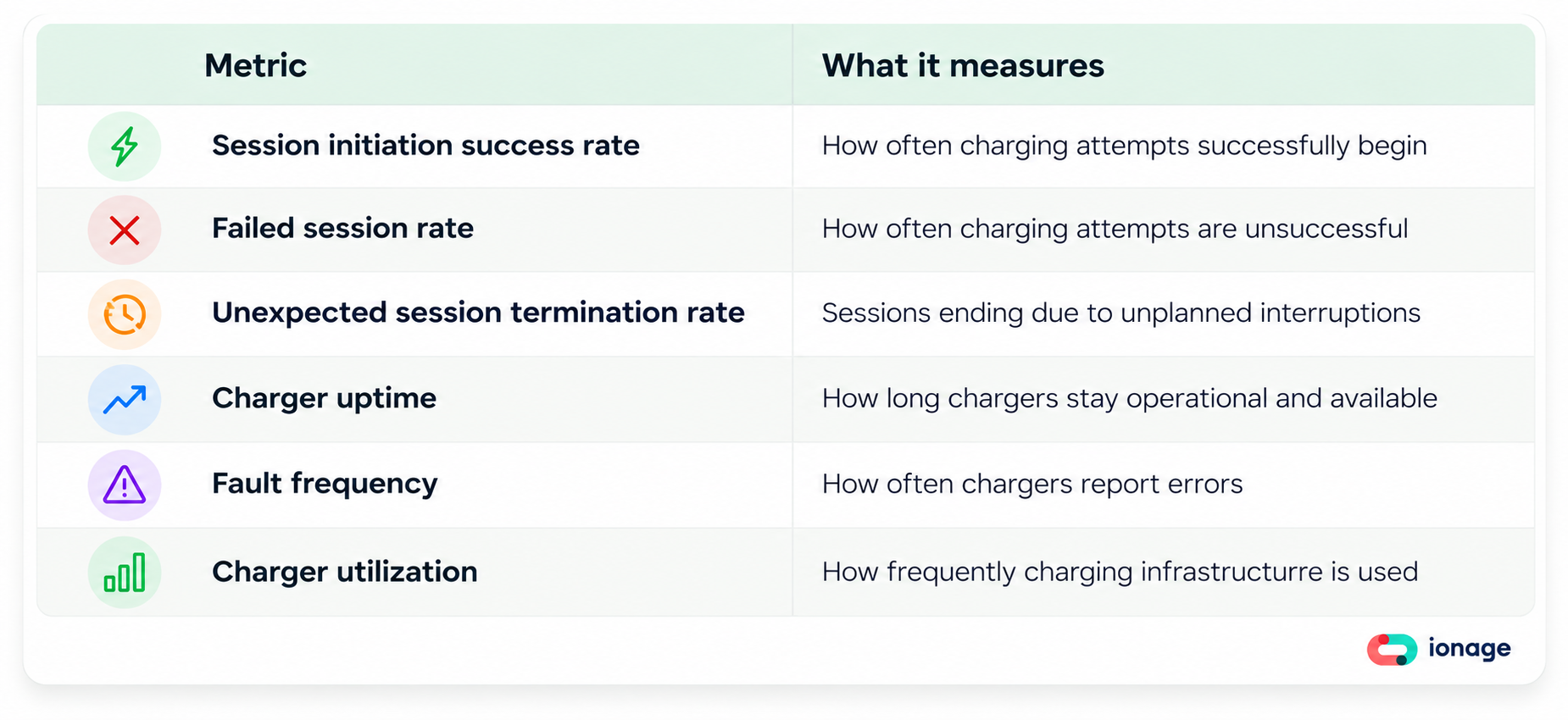
Tracked together, these metrics show reliability well beyond basic charger availability.
10. Prevent Failures With Regular Maintenance
You can't prevent every failure, but regular maintenance cuts down avoidable hardware issues.
A solid maintenance routine should cover:
- Inspecting connectors and cables
- Checking electrical connections and safety systems
- Reviewing recurring charger errors
- Verifying charger connectivity
- Keeping firmware versions compatible
- Testing chargers after repairs
- Watching hardware that frequently needs intervention
Let past charging performance guide your maintenance priorities. If a charger keeps recording failed sessions, it deserves a closer look, even if it appears operational right now.
Fixing recurring issues early stops them from spreading to more sessions.
11. Build a Clear Process for Handling Failed Sessions
Spotting a failed session is only half the job. Teams also need a structured way to resolve it.
A practical troubleshooting workflow looks like this:
- Identify the failure
- Review the session data
- Determine the likely cause
- Attempt remote troubleshooting
- Escalate if required
- Verify that charging works again
The cause decides the response. An authentication failure points the team toward the user authorization process, not a technician dispatch. A damaged connector, on the other hand, needs physical intervention.
Clear ownership and escalation paths help teams respond faster. They also stop repeated failures from being treated as unrelated incidents.
12. Why Centralized Charging Management Software Matters
As a network grows, so does everything that comes with it: more sessions, more users, more chargers, and more operational issues. Managing all of that across separate systems or manual processes makes problems harder to spot.
A Charging Point Management System (CPMS) brings core charging operations into one place. It can help CPOs with:
- Monitoring charger status
- Reviewing charging session records
- Identifying operational faults
- Managing supported remote operations
- Tracking network performance
- Managing chargers across multiple locations
With operational information in one place, troubleshooting becomes more structured. Instead of looking at each charger in isolation, operators can assess problems across the whole network and prioritize the locations that need attention first.
13. Manage Charging Operations With IONAGE Nexus
IONAGE Nexus is a charging management platform built to help Charge Point Operators manage and scale their EV charging networks. It brings essential charging operations into one centralized system, so CPOs keep visibility across their infrastructure.
IONAGE Nexus supports:
- OCPP-based charger management
- Real-time charger status monitoring
- Charging session management
- Charger and network performance visibility
- Tariff management
- User roles and access control
- Payments, payouts, and settlements
- OCPI roaming and external network integrations
- APIs and integrations
When a session fails, having charger status and session information in one platform makes the issue easier to review. And as your network expands, that visibility helps you run day-to-day operations smoothly and keep the charging experience consistent.
Make Every Charging Session Count
A charging network's reliability isn't measured by how many chargers are installed or how often they show up online. For EV drivers, only one thing matters: can they charge when they need to?
Improving charging session success rates comes down to understanding why failures happen, monitoring charger performance, reviewing session data, and following clear troubleshooting processes. Pair those practices with the right EV charging management software, and operators can cut avoidable failures and build a network drivers can depend on.
Every failed session should leave you with more than a support ticket. It should show you what to fix next.
IONAGE Nexus gives CPOs greater visibility and control over their charging operations, making it easier to manage the network as it grows.
Book a demo with IONAGE Nexus to see how centralized charging management can support your operations.
Frequently Asked Questions
1. Why do EV charging sessions fail?
EV charging sessions can fail because of charger hardware faults, network connectivity problems, authentication errors, communication failures, vehicle compatibility issues, or payment problems. Finding the exact cause usually means reviewing charger status, session records, and available diagnostic information.
2. Can an EV charger be online but still fail to start charging?
Yes. A charger can stay connected to its backend while connector faults, authorization issues, or other problems stop a session from starting. That's why CPOs should track both charger uptime and charging session success rate.
3. How can CPOs improve EV charging session success rates?
CPOs can improve success rates through real-time monitoring, reviewing failed session data, preventive maintenance, supported remote troubleshooting, and structured escalation processes. Tracking failures consistently helps surface recurring operational problems.
4. How does OCPP help troubleshoot failed charging sessions?
OCPP enables communication between compatible EV chargers and charging management systems. Depending on the implementation, it can provide charger status, transaction events, error information, and diagnostic data that help operators investigate failures.
5. How can IONAGE Nexus help manage failed EV charging sessions?
IONAGE Nexus offers centralized charger monitoring, charging session management, and network performance visibility. Together, these help CPOs review charging activity, identify operational issues, and manage charging infrastructure across multiple locations.
As the world shifts gears toward a more sustainable future, the way we drive is changing—fast. Are you in the market for an EV? In your research, you might have come across different EV and Hybrid technologies from various manufacturers. Was it confusing or complex? We are here to de-mystify and help in your decision.
No worries—we’re here to break it down! Let’s explore the key differences between Electric Vehicles (EVs) and Hybrid Vehicles, so you can make the right choice.
What is the deal with electric vehicles (EV’s)
Electric vehicles run purely on electricity and are powered by rechargeable batteries that run the electric motor. That’s it. Here are a few reasons that give EVs an unfair advantage:
- Modern Design and Ownership: EVs have changed the fundamentals of the vehicle. You see a much more modern aesthetic and design for EVs. Additionally, this helps EV manufacturers develop innovative ways of ownership such as the MG Windsor.
- Lower Running Costs: The charge per kilometer for EVs is much lower than running on gas. Also, fewer running parts mean lesser maintenance.
- Eco-Friendly: With zero emissions, EVs are cleaner and quieter than traditional cars, contributing to reduced pollution and better air quality. Good for the planet, good for your lungs!
But it’s not all sunshine and supercharging. EVs do have some limits, especially when it comes to range. Currently, You’ll need to plan ahead if you’re going on a long road trip, but hey—that’s what apps and fast chargers are for! Then there is the question of batteries.

The Hybrid Vehicle: Best of Both Worlds?
If you're not ready to go fully electric yet, the next available option is a hybrid Vehicle. A hybrid vehicle uses a combination of gasoline and electric power to drive the vehicle. Hybrid technologies are considered a great intermediate step before the grand march toward a fully EV world. This makes them easy to recommend.
Here’s why a Hybrid Vehicle might be considered:
- Better Fuel Efficiency: Since hybrids can use electricity to supplement gasoline, they use less fuel overall—making them more efficient than traditional gas-powered cars.
- Extended Range: Worried about running out of charge? Hybrids still have gasoline backup, so you can go the distance without range anxiety.
- Familiarity: between EV and ICE, Hybrids feel like traditional fuel-powered cars but add a sustainable twist. It's just like an extension of an ICE.
Before pegging on the Hybrid Vehicle, consider the following.
- Space and Design: Hybrid Vehicles need to have batteries as well as a combustion engine. This greatly reduces space efficiency. Big boxes for the next adventure would be difficult to fit. They are also not as quiet as EVs. The design tends to be closer to traditional automotive without the advantages of the modern EV experience.
- Extended Range: Worried about running out of charge? Hybrids still have gasoline backup, so you can go the distance without range anxiety.
- Familiarity: between EV and ICE, Hybrids feel like traditional fuel-powered cars but add a sustainable twist. It's just like an extension of an ICE.
Still, for those who aren’t ready to take the full EV plunge, hybrids offer a solid first step.
Which One Should You Choose?
Ultimately, deciding between an EV and a Hybrid Vehicle comes down to your lifestyle and driving needs.
- If you’re all about cutting emissions and want the latest tech with the lowest environmental impact, go electric. You’ll be doing your part to keep the planet green while enjoying cutting-edge innovation.
- If you’re not ready to give up the flexibility of gasoline but still want to reduce your carbon footprint, a hybrid might be the perfect compromise.
At Ionage Technologies, we believe in the power of choice—because there’s no one-size-fits-all answer when it comes to sustainable driving. Whether you choose a full EV or a hybrid, both options represent a step toward a cleaner, smarter future.
Wrapping it up: the road ahead
As EV charging infrastructure grows and technology improves, the gap between electric and hybrid vehicles is closing fast. More people are embracing electric mobility, and the future looks bright. Whichever path you choose, it’s clear that sustainable mobility is the destination.
Ready to make your move? Join us on the journey to electrify the roads and drive toward a greener tomorrow.