In This Blog
Get tips, updates & exclusives—no spam


BLOGS
EV Fleet Charging Software vs Traditional Charging Management: What Modern Fleets Need
Fleet Charging

EV Fleet Charging Software vs Traditional Charging Management: What Modern Fleets Need
The rapid adoption of electric vehicles is transforming fleet operations across logistics, mobility, public transport, and last-mile delivery. But while fleets are electrifying faster than ever, many operators are still managing charging operations using fragmented systems, manual coordination, and disconnected charging networks.
This is where EV fleet charging software is becoming essential.
Modern EV fleets require more than just access to chargers. They need centralized visibility, operational intelligence, optimized charging workflows, and seamless financial management to scale efficiently.
Traditional charging management methods were not designed for the complexity of large-scale EV operations. As fleets grow, these limitations lead to higher operational costs, reduced vehicle utilization, charging inefficiencies, and poor driver experience.
Today, advanced EV fleet charging software platforms are helping operators simplify charging access, reduce costs, improve operational efficiency, and scale fleet operations through unified charging ecosystems.
What is Traditional Charging Management?
Traditional charging management refers to fragmented and largely manual approaches used by fleet operators to manage EV charging operations.
In many cases, fleets rely on:
- Separate agreements with multiple charging point operators (CPOs)
- Different dashboards and charging apps
- Manual invoice reconciliation
- Offline charging coordination
- Limited visibility into charging performance
- Static charging schedules
While this approach may work for smaller EV deployments, it becomes increasingly inefficient as fleet size and charging demand grow.
Fleet operators often struggle with:
- Inconsistent charging availability
- Unpredictable charging costs
- Operational delays
- Underutilized charging infrastructure
- Lack of charging analytics
- Difficult financial reconciliation
As EV adoption accelerates, these disconnected systems create operational bottlenecks that directly impact fleet productivity.
What is EV Fleet Charging Software?
EV fleet charging software is a centralized digital platform that helps fleet operators manage, optimize, and scale charging operations across multiple charging networks and charging locations.
Instead of relying on disconnected systems, fleet operators can manage charging operations through one unified interface.
Modern EV fleet charging software enables:
- Aggregated access to EV fleet charging stations
- Real-time charging visibility
- Smart charging management
- Automated billing and settlements
- Charging analytics and reporting
- Vehicle-level charging insights
- Multi-network interoperability
- Route-aware charging optimization
By centralizing charging operations, fleet operators gain better control over charging infrastructure, operational costs, and vehicle uptime.
Traditional Charging Management vs EV Fleet Charging Software
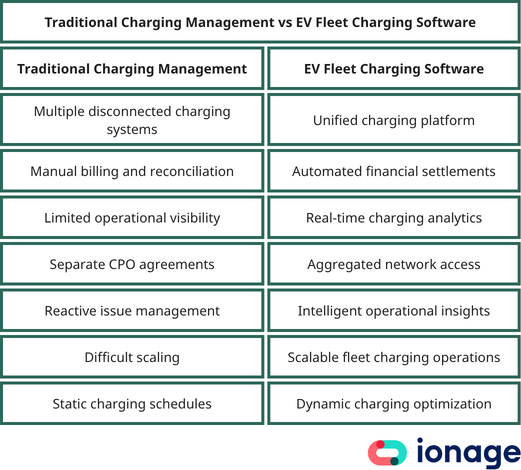
The difference is no longer just operational convenience. It directly impacts:
- fleet utilization
- operational efficiency
- energy costs
- charging uptime
- scalability
Key Challenges Modern EV Fleets Face
Fragmented Charging Networks
Many fleet operators work with multiple charging point operators across cities, depots, and public charging corridors.
This creates:
- multiple contracts
- inconsistent pricing structures
- disconnected charging experiences
- operational inefficiencies
Drivers are often forced to use different charging apps, while fleet managers struggle to manage fragmented infrastructure access.
Unpredictable Charging Costs
Charging tariffs vary across operators, locations, and time periods.
Without centralized visibility into pricing and charging behavior, fleets face:
- higher charging costs
- inefficient charging patterns
- poor energy utilization
- inconsistent commercial terms
As fleets scale, these inefficiencies compound rapidly.
Limited Operational Visibility
Traditional charging systems provide limited insight into:
- charger utilization
- charging dwell time
- charging session trends
- vehicle-level charging behavior
- route-based charging demand
Without real-time visibility, operators struggle to optimize fleet charging operations effectively.
Manual Financial Operations
Managing invoices, settlements, reimbursements, and billing across multiple charging operators becomes increasingly complex at scale.
Manual financial processes create:
- reconciliation delays
- billing errors
- administrative overhead
- reduced operational efficiency
How EV Fleet Charging Software Solves These Challenges
Unified Network Access
Modern EV fleet charging software connects fleets with multiple charging networks through one platform.
Instead of negotiating and managing separate charging systems individually, fleet operators gain centralized access to EV fleet charging stations and charging hubs across regions.
This reduces operational friction while improving charging accessibility for drivers.
Smart Charging Insights
Advanced charging analytics help operators understand:
- charging patterns
- charger utilization
- session duration
- dwell time
- energy consumption trends
- vehicle-specific charging behavior
These insights help fleets optimize charging schedules, reduce idle time, and improve charging efficiency across operations.
Automated Financial Management
EV fleet charging software simplifies financial operations through:
- automated invoicing
- prepaid and postpaid billing
- centralized settlements
- digital reconciliation
- transparent pricing structures
This eliminates the operational burden of managing multiple charging operators manually.
Improved Operational Efficiency
By using centralized operational visibility, fleet operators can:
- improve vehicle turnaround times
- reduce charging delays
- optimize charging schedules
- minimize charger congestion
- increase fleet uptime
As charging demand grows, intelligent charging coordination becomes critical for operational continuity.
Why Modern Fleets Are Moving Toward Marketplace-Based Charging Platforms
The future of EV fleet charging is shifting toward open, interoperable charging ecosystems.
Instead of operating within isolated charging networks, fleets increasingly require:
- aggregated charging access
- interoperable charging infrastructure
- transparent pricing models
- scalable charging ecosystems
- seamless operational visibility
Marketplace-based charging platforms help fleets scale without being locked into fragmented charging environments.
This approach enables:
- broader charging access
- operational flexibility
- simplified commercial management
- faster infrastructure scalability
As EV adoption accelerates, interoperability will become one of the most important factors in fleet charging operations.
How IONAGE FLO Supports Modern EV Fleet Operations
IONAGE FLO is designed to simplify and optimize EV fleet charging operations through an open marketplace approach.
FLO connects fleet operators and charging point operators through a unified digital platform that enables:
- aggregated charging network access
- transparent pricing
- smart commercial workflows
- automated settlements
- charging analytics
- operational visibility
By centralizing charging operations, FLO helps fleets reduce operational complexity while improving scalability and charging efficiency.
Fleet operators can use FLO to:
- access multiple charging networks through one platform
- monitor charging patterns and session behavior
- optimize charging operations using operational insights
- simplify financial reconciliation
- improve charging visibility across fleets
As charging infrastructure expands, platforms like FLO will play a critical role in enabling scalable EV fleet operations.
The Future of EV Fleet Charging Operations
The next generation of EV fleet operations will be driven by:
- connected charging ecosystems
- intelligent charging optimization
- interoperable charging infrastructure
- real-time operational analytics
- automated commercial workflows
- data-driven charging decisions
Fleet charging is evolving from a simple energy transaction into a highly strategic operational function.
Operators that adopt intelligent EV fleet charging software early will be better positioned to:
- scale efficiently
- reduce operational costs
- improve vehicle utilization
- optimize charging infrastructure usage
- deliver more reliable fleet operations
Conclusion
Traditional charging management methods are no longer sufficient for large-scale EV fleet operations.
As fleets continue to grow, operators need centralized platforms that provide visibility, interoperability, operational intelligence, and scalable charging access.
EV fleet charging software is becoming the operational backbone of modern electric mobility fleets.
By simplifying charging management, improving operational efficiency, and enabling intelligent charging decisions, platforms like IONAGE FLO are helping shape the future of connected EV fleet ecosystems.
Book a demo to discover how IONAGE FLO can help your fleet access smarter charging networks, optimize charging operations, and scale EV fleet management efficiently.
As the world shifts gears toward a more sustainable future, the way we drive is changing—fast. Are you in the market for an EV? In your research, you might have come across different EV and Hybrid technologies from various manufacturers. Was it confusing or complex? We are here to de-mystify and help in your decision.
No worries—we’re here to break it down! Let’s explore the key differences between Electric Vehicles (EVs) and Hybrid Vehicles, so you can make the right choice.
What is the deal with electric vehicles (EV’s)
Electric vehicles run purely on electricity and are powered by rechargeable batteries that run the electric motor. That’s it. Here are a few reasons that give EVs an unfair advantage:
- Modern Design and Ownership: EVs have changed the fundamentals of the vehicle. You see a much more modern aesthetic and design for EVs. Additionally, this helps EV manufacturers develop innovative ways of ownership such as the MG Windsor.
- Lower Running Costs: The charge per kilometer for EVs is much lower than running on gas. Also, fewer running parts mean lesser maintenance.
- Eco-Friendly: With zero emissions, EVs are cleaner and quieter than traditional cars, contributing to reduced pollution and better air quality. Good for the planet, good for your lungs!
But it’s not all sunshine and supercharging. EVs do have some limits, especially when it comes to range. Currently, You’ll need to plan ahead if you’re going on a long road trip, but hey—that’s what apps and fast chargers are for! Then there is the question of batteries.

The Hybrid Vehicle: Best of Both Worlds?
If you're not ready to go fully electric yet, the next available option is a hybrid Vehicle. A hybrid vehicle uses a combination of gasoline and electric power to drive the vehicle. Hybrid technologies are considered a great intermediate step before the grand march toward a fully EV world. This makes them easy to recommend.
Here’s why a Hybrid Vehicle might be considered:
- Better Fuel Efficiency: Since hybrids can use electricity to supplement gasoline, they use less fuel overall—making them more efficient than traditional gas-powered cars.
- Extended Range: Worried about running out of charge? Hybrids still have gasoline backup, so you can go the distance without range anxiety.
- Familiarity: between EV and ICE, Hybrids feel like traditional fuel-powered cars but add a sustainable twist. It's just like an extension of an ICE.
Before pegging on the Hybrid Vehicle, consider the following.
- Space and Design: Hybrid Vehicles need to have batteries as well as a combustion engine. This greatly reduces space efficiency. Big boxes for the next adventure would be difficult to fit. They are also not as quiet as EVs. The design tends to be closer to traditional automotive without the advantages of the modern EV experience.
- Extended Range: Worried about running out of charge? Hybrids still have gasoline backup, so you can go the distance without range anxiety.
- Familiarity: between EV and ICE, Hybrids feel like traditional fuel-powered cars but add a sustainable twist. It's just like an extension of an ICE.
Still, for those who aren’t ready to take the full EV plunge, hybrids offer a solid first step.
Which One Should You Choose?
Ultimately, deciding between an EV and a Hybrid Vehicle comes down to your lifestyle and driving needs.
- If you’re all about cutting emissions and want the latest tech with the lowest environmental impact, go electric. You’ll be doing your part to keep the planet green while enjoying cutting-edge innovation.
- If you’re not ready to give up the flexibility of gasoline but still want to reduce your carbon footprint, a hybrid might be the perfect compromise.
At Ionage Technologies, we believe in the power of choice—because there’s no one-size-fits-all answer when it comes to sustainable driving. Whether you choose a full EV or a hybrid, both options represent a step toward a cleaner, smarter future.
Wrapping it up: the road ahead
As EV charging infrastructure grows and technology improves, the gap between electric and hybrid vehicles is closing fast. More people are embracing electric mobility, and the future looks bright. Whichever path you choose, it’s clear that sustainable mobility is the destination.
Ready to make your move? Join us on the journey to electrify the roads and drive toward a greener tomorrow.