In This Blog
Get tips, updates & exclusives—no spam


BLOGS
Every EV Charging App in India, Compared (And Why You Might Only Need One)
Ev Charging

Every EV Charging App in India, Compared (And Why You Might Only Need One)
India's EV revolution is real. But charging your car? That's still a mess.
Why the Fragmentation Exists
India's EV charging infrastructure wasn't built by one company with one vision. It was built by dozens of companies, each trying to capture a slice of a fast-growing market.
Energy conglomerates built chargers at fuel stations. Two-wheeler manufacturers built proprietary grids for their own vehicles. Startups raised funding and planted stations at malls, highways, and office parks. Each CPO (Charge Point Operator) built its own network, its own app, its own wallet, its own experience.
The result? Dozens of charging networks operate across India today, each sitting behind its own login screen.
This fragmentation isn't an accident. It's the natural outcome of a market where every operator optimised for their own growth, not yours. And as the driver, you're the one paying the price.
How the Major Categories of Charging Apps Fall Short
CPO apps in India broadly fall into a few categories. Each does something reasonably well. Each leaves meaningful gaps.
The Large Utility Network App
Some of India's biggest energy companies have built wide charging networks, leveraging existing real estate like fuel stations and commercial properties. Many also cover major national highways, benefiting from decades of physical infrastructure presence.
What they do well: Scale. These networks often have strong coverage along major highways and in large cities. Hardware is relatively reliable. For drivers who stay within the metros and on well-travelled corridors, these apps get the job done.
The gaps: Because charging is built onto existing real estate as an add-on, amenities are minimal to none. These stations were not planned with the EV driver in mind. They were planted where land already existed, not where charging infrastructure would be most useful. The experience reflects that.
The OEM-Tied App
Several EV manufacturers have built charging networks designed specifically for their own vehicles and the apps that come with them.
What they do well: Deep integration with the vehicle. Smooth in-network experience. Well-maintained stations in cities where the manufacturer has a strong presence.
The gaps: The primary intention behind these networks is reducing range anxiety to drive vehicle sales. Charging is a feature, not a product. As a result, there is little focus on customer experience or value additions beyond the basics. Improvements and innovations are rare. Once you've bought the car, the app's evolution largely stops.
The Startup Network App
A new generation of charging-focused startups has built dense networks in urban areas and along specific highway corridors.
What they do well: Competitive pricing, good urban density, and often a cleaner app experience than legacy operators. Growing fast.
The gaps: Coverage is strong in specific regions, primarily Bengaluru, Pune, Delhi-NCR, and parts of Maharashtra and Gujarat, but inconsistent beyond these clusters. More structurally, most startup apps are built on whitelabelled solutions, which means the majority look and feel nearly identical. A genuinely customer-oriented charging app is rare. And like every other CPO app, it only shows you its own stations, a fraction of what's actually available.
The Pattern You'll Notice
Every category has a version of the same problem:
- They show you their stations, not all stations
- They give you their pricing, not the best pricing for your trip
- They manage their wallet, not a universal one you can use anywhere
- They plan routes on their network, not the optimal route across India
The driver ends up managing 4 to 7 apps, multiple wallets, and a patchwork mental map of which app works where, at exactly the moment they should be focused on the road.
What IONAGE Does Differently
IONAGE was built on a simple premise: EV drivers shouldn't have to solve a market structure problem.
Access to India's largest unified charging network
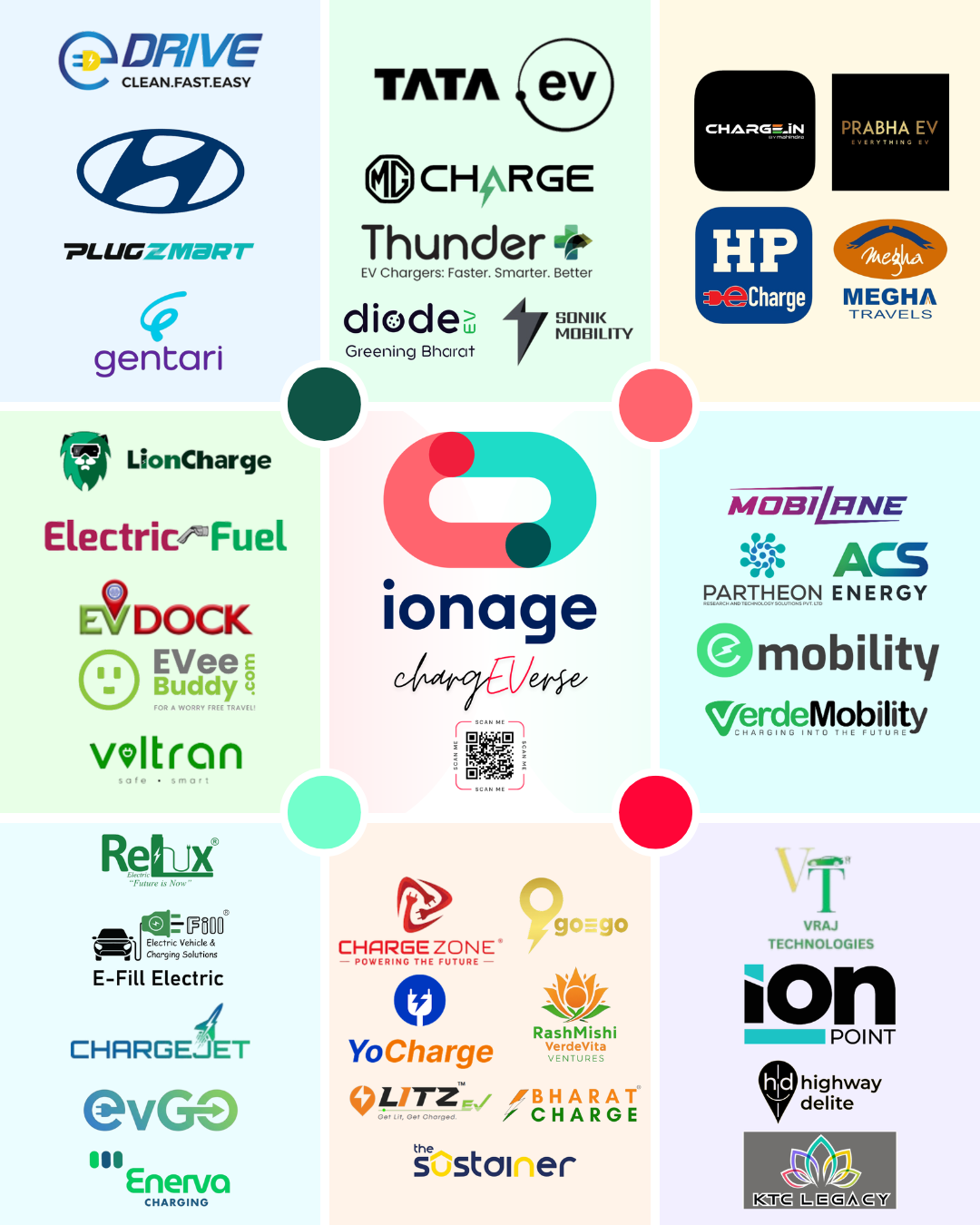
IONAGE brings together 50+ CPOs and 16,000+ charging points onto a single platform, making it India's largest unified EV charging platform. You're not seeing one corner of one network. You're seeing the most complete picture available anywhere.
This matters most when you don't know what you don't know. The best charger for your next stop might be on a network you've never heard of. IONAGE makes sure you see it.
Real data to compare stations confidently
Finding a station is only half the problem. Trusting it is the other half.
IONAGE shows you the metrics that matter before you commit: success rate, last-used time, real-time availability, connector types, and distance. You can compare across stations and networks the same way you'd compare flights, with all the information visible at once, not scattered across multiple apps.
Trip planning that works end-to-end
.png)
Planning a long-distance EV trip through individual CPO apps is like planning a road trip by calling each petrol pump separately. You stitch together a route, hope the stations work, and start over if anything breaks.
IONAGE plans your trip across the best available stations across the country. Not the best stations on one network. The best stations, period. Your route is built around what's actually optimal for your battery, your vehicle, and your destination.
One wallet. One seamless experience.
Managing separate wallets for different CPOs isn't just inconvenient. It's a real friction point when you're at a charger and need to act fast.
With IONAGE, one wallet works across thousands of stations. 9 lakh+ charging sessions completed. One app, one consistent experience, no switching between platforms.
The Bottom Line
India needs more charging networks, and IONAGE is how you access all of them, without the chaos.
It doesn't ask you to pick a network. It doesn't make you manage multiple wallets. It doesn't leave you wondering whether a better station sits two kilometres away on an app you haven't downloaded.
It shows you everything, helps you choose with confidence, and gets you back on the road.
Download IONAGE, India's largest unified EV charging platform and access platform.
As the world shifts gears toward a more sustainable future, the way we drive is changing—fast. Are you in the market for an EV? In your research, you might have come across different EV and Hybrid technologies from various manufacturers. Was it confusing or complex? We are here to de-mystify and help in your decision.
No worries—we’re here to break it down! Let’s explore the key differences between Electric Vehicles (EVs) and Hybrid Vehicles, so you can make the right choice.
What is the deal with electric vehicles (EV’s)
Electric vehicles run purely on electricity and are powered by rechargeable batteries that run the electric motor. That’s it. Here are a few reasons that give EVs an unfair advantage:
- Modern Design and Ownership: EVs have changed the fundamentals of the vehicle. You see a much more modern aesthetic and design for EVs. Additionally, this helps EV manufacturers develop innovative ways of ownership such as the MG Windsor.
- Lower Running Costs: The charge per kilometer for EVs is much lower than running on gas. Also, fewer running parts mean lesser maintenance.
- Eco-Friendly: With zero emissions, EVs are cleaner and quieter than traditional cars, contributing to reduced pollution and better air quality. Good for the planet, good for your lungs!
But it’s not all sunshine and supercharging. EVs do have some limits, especially when it comes to range. Currently, You’ll need to plan ahead if you’re going on a long road trip, but hey—that’s what apps and fast chargers are for! Then there is the question of batteries.
The Hybrid Vehicle: Best of Both Worlds?
If you're not ready to go fully electric yet, the next available option is a hybrid Vehicle. A hybrid vehicle uses a combination of gasoline and electric power to drive the vehicle. Hybrid technologies are considered a great intermediate step before the grand march toward a fully EV world. This makes them easy to recommend.
Here’s why a Hybrid Vehicle might be considered:
- Better Fuel Efficiency: Since hybrids can use electricity to supplement gasoline, they use less fuel overall—making them more efficient than traditional gas-powered cars.
- Extended Range: Worried about running out of charge? Hybrids still have gasoline backup, so you can go the distance without range anxiety.
- Familiarity: between EV and ICE, Hybrids feel like traditional fuel-powered cars but add a sustainable twist. It's just like an extension of an ICE.
Before pegging on the Hybrid Vehicle, consider the following.
- Space and Design: Hybrid Vehicles need to have batteries as well as a combustion engine. This greatly reduces space efficiency. Big boxes for the next adventure would be difficult to fit. They are also not as quiet as EVs. The design tends to be closer to traditional automotive without the advantages of the modern EV experience.
- Extended Range: Worried about running out of charge? Hybrids still have gasoline backup, so you can go the distance without range anxiety.
- Familiarity: between EV and ICE, Hybrids feel like traditional fuel-powered cars but add a sustainable twist. It's just like an extension of an ICE.
Still, for those who aren’t ready to take the full EV plunge, hybrids offer a solid first step.
Which One Should You Choose?
Ultimately, deciding between an EV and a Hybrid Vehicle comes down to your lifestyle and driving needs.
- If you’re all about cutting emissions and want the latest tech with the lowest environmental impact, go electric. You’ll be doing your part to keep the planet green while enjoying cutting-edge innovation.
- If you’re not ready to give up the flexibility of gasoline but still want to reduce your carbon footprint, a hybrid might be the perfect compromise.
At Ionage Technologies, we believe in the power of choice—because there’s no one-size-fits-all answer when it comes to sustainable driving. Whether you choose a full EV or a hybrid, both options represent a step toward a cleaner, smarter future.
Wrapping it up: the road ahead
As EV charging infrastructure grows and technology improves, the gap between electric and hybrid vehicles is closing fast. More people are embracing electric mobility, and the future looks bright. Whichever path you choose, it’s clear that sustainable mobility is the destination.
Ready to make your move? Join us on the journey to electrify the roads and drive toward a greener tomorrow.