In This Blog
Get tips, updates & exclusives—no spam


BLOGS
How Can CPOs Manage Public, Private, and Fleet Charging on One Platform?
CPO
Featured

How Can CPOs Manage Public, Private, and Fleet Charging on One Platform?
The EV charging business is no longer limited to installing chargers and making them available to the public.
Today, a Charge Point Operator (CPO) might manage a highway charging station accessible to everyone, private chargers at a corporate office, and dedicated charging infrastructure for a logistics fleet.
All three serve the same fundamental purpose: charging electric vehicles. But the way they operate can be very different.
Public charging requires easy accessibility, transparent pricing, and seamless payments. Private charging needs controlled access and customised billing. Fleet charging often involves dedicated users, negotiated tariffs, and consolidated reporting.
For CPOs operating across these segments, managing everything through separate systems can quickly become complicated.
The question is: Does every charging model need its own management system, or can one platform handle them all?
Let's explore.
Understanding Public, Private, and Fleet EV Charging
Before understanding how to manage them together, it's important to recognise what makes each charging model different.
1. Public EV Charging
Public charging stations are accessible to EV users, typically at highways, commercial properties, fuel stations, and other public locations.
For CPOs, the priority is ensuring chargers are available, discoverable, and functioning properly.
They need to manage:
- Charging station availability and operational status
- Public access and session initiation
- Charging tariffs and payments
- Session monitoring and transaction records
- Charger uptime and performance
Since public charging involves different users throughout the day, the system must support consistent operations without requiring manual intervention for every session.
2. Private EV Charging
Private charging infrastructure is generally installed at corporate offices, residential societies, hotels, and commercial properties where access may be restricted to authorised users.
Unlike public charging, not everyone should necessarily be able to start a session.
For example, a company might provide charging access only to employees, while a residential society might restrict chargers to registered residents.
Here, CPOs need control over who can use the chargers, how much they pay, and how consumption is recorded.
3. Fleet EV Charging
Fleet charging is designed for businesses operating multiple electric vehicles, such as logistics companies, mobility providers, and commercial transport operators.
Fleet operators may require dedicated charging infrastructure or access to chargers operated by different CPOs.
Their requirements often include:
- Access for authorised fleet vehicles or users
- Negotiated commercial charging tariffs
- Charging session and energy consumption tracking
- Consolidated billing and invoices
- Charging infrastructure availability and reliability
For a CPO serving several fleet customers, managing different commercial agreements and charging requirements can add another layer of operational complexity.
Why Managing Different Charging Models Becomes Complicated
Imagine a CPO operating 50 chargers across multiple locations.
Some chargers are available to the public, others are reserved for corporate customers, and a few are dedicated to commercial fleets.
If each category operates through a different software system, the CPO may have to switch between dashboards to monitor charger status, review transactions, update pricing, and generate reports.
As the network grows, this fragmented approach creates several challenges.
Limited operational visibility: Without a centralised view, understanding overall network performance becomes difficult. A charger could be offline at one location while the operations team is busy monitoring another system.
Inconsistent access management: Public users, employees, residents, and fleet customers require different permissions. Managing these permissions manually increases administrative work and the chances of configuration errors.
Complicated tariff management: A single CPO may offer standard public pricing, discounted employee rates, and contracted fleet tariffs. Maintaining these structures independently can make pricing updates more time-consuming.
Multiple billing processes: Different customer groups may need different invoice formats, billing cycles, and settlement arrangements.
Fragmented reporting: When data is spread across systems, comparing charging activity, utilisation, and revenue becomes more difficult.
The challenge isn't necessarily the number of chargers. It's the number of operational rules a CPO must manage.
This is where centralised EV charging management software becomes valuable.
How Can One EV Charging Management Platform Handle All Three?
A modern Charge Point Management System (CPMS) can help CPOs operate different charging models from a single platform while maintaining separate access policies, tariffs, and billing arrangements.
Here's how.
1. Monitor Every Charger from One Dashboard
Whether a charger is located at a public highway station, inside a corporate campus, or at a fleet depot, the CPO needs to know what's happening with it.
A centralised dashboard can provide visibility into:
- Real-time charger status
- Active and completed charging sessions
- Charger faults and communication issues
- Energy consumption
- Uptime and operational performance
Instead of monitoring multiple systems independently, operations teams can identify issues and review network performance from one place.
For example, if a fleet charger goes offline during scheduled vehicle operations, the team can identify the problem through monitoring alerts and take appropriate action.
The same monitoring infrastructure can also support public and private charging locations.
The benefit is straightforward: different charging operations, but one view of network performance.
2. Control Who Can Access Each Charger
One of the biggest differences between public, private, and fleet charging is access.
A public charger may be available to any eligible EV user. A corporate charger may be restricted to employees, while a fleet charger may only be available to authorised commercial users.
A unified platform should allow CPOs to create different customer groups and assign access permissions accordingly.
Depending on the software and charger capabilities, authentication may happen through a mobile app, RFID card, or Autocharge.
Consider a commercial property with chargers serving employees, visitors, and a contracted fleet.
The CPO might configure:
- Public visitors to access designated public chargers
- Employees to use chargers assigned to their organisation
- Fleet customers to access specific chargers under their agreement
All these permissions can be managed centrally without needing separate backend systems for each customer group.
This flexibility is particularly useful for CPOs operating mixed-use charging locations.
3. Set Different Charging Tariffs for Different Users
Not every charging session needs to follow the same pricing structure.
A public charging customer might pay the standard tariff, while a corporate customer may receive a preferential rate. A fleet operator could have a separately negotiated commercial price.
For CPOs, the ability to configure and manage these tariffs is essential.
A capable EV charging management platform can support different pricing configurations based on factors such as charging location, customer group, charger type, or commercial arrangement.
For example:
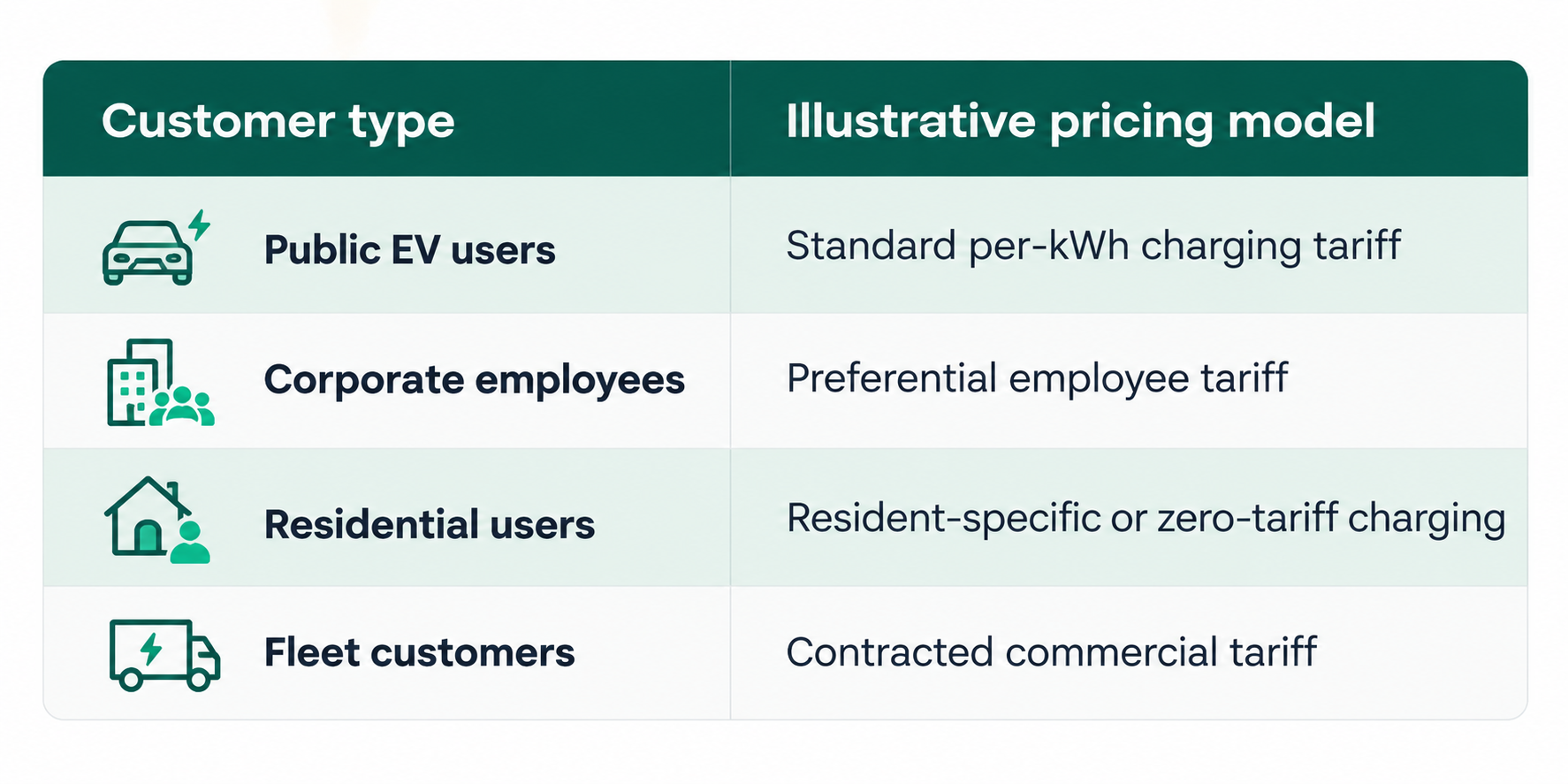
These are examples of possible configurations, not fixed industry-wide pricing rules.
Centralised tariff management allows CPOs to maintain control over pricing across different business models without updating each arrangement in an entirely separate system.
It also makes tariff changes easier to track and manage as the network expands.
4. Simplify Billing, Payments, and Reconciliation
Charging a vehicle is only one part of the transaction. CPOs also need to ensure that the session is recorded, the correct tariff is applied, and the financial information is available for billing and reconciliation.
The process can vary significantly between charging models.
Public charging generally involves individual transactions. Corporate charging may require periodic consumption reports, while fleet customers may prefer consolidated invoices covering multiple vehicles and sessions.
Without centralised records, managing these transactions can become time-consuming.
EV charging management software can help CPOs organise:
- Charging session histories
- Energy consumption records
- Applicable tariffs and transaction amounts
- Customer-specific billing reports
- Revenue and settlement information
- Invoice generation and reconciliation
This reduces dependence on manually compiling information from different sources.
It also helps CPOs maintain clearer financial records across their public, private, and fleet charging operations.
5. Understand Which Charging Segments Are Performing Better
Managing chargers is important, but understanding their performance is equally valuable.
Consider a CPO operating public charging stations alongside dedicated fleet chargers.
The public stations may experience higher usage during weekends, while fleet chargers could see more consistent activity during working hours.
Without reliable data, these patterns may go unnoticed.
A unified platform can help CPOs evaluate metrics such as:
Charger utilisation: How frequently are chargers being used?
Energy consumption: How much electricity is delivered across different charging segments?
Session success rates: How many charging attempts are completed successfully?
Revenue performance: Which locations or customer segments generate more revenue?
Charger uptime: How reliably is the infrastructure operating?
These insights can support operational improvements, pricing decisions, maintenance planning, and future network expansion.
For example, a consistently underutilised public charger may need better visibility or a review of its pricing strategy. A heavily used fleet charging location may require additional capacity.
When performance information is available in one system, CPOs can make more informed decisions across their entire network.
A Practical Example: One CPO Managing Three Charging Models
Let's consider a hypothetical charging operator called ABC Charging.
The company manages three types of charging infrastructure:
Location A: Highway charging station
The chargers are available to public EV users. Customers pay standard charging tariffs, and the CPO monitors sessions, payments, and charger availability.
Location B: Corporate office
Chargers are reserved for registered employees. Access is restricted, and charging sessions are recorded against the relevant users or organisation.
Location C: Logistics fleet depot
Chargers are used by an authorised logistics fleet. The company follows an agreed commercial tariff and requires periodic charging and energy consumption reports.
With separate management systems, ABC Charging would need to handle monitoring, user permissions, tariffs, and reporting independently for each location.
With a unified charging management platform, the operator can manage these configurations through one centralised system.
Each location retains its own operating rules, but the CPO gains a consolidated view of the charging network.
The result is a simpler operational structure that can become increasingly valuable as the business adds more chargers, customers, and locations.
What Should CPOs Look for in a Unified EV Charging Management Platform?
Not every charging management platform supports every operating model in the same way.
Before selecting software, CPOs should evaluate whether it can support both their current business and future expansion plans.
Here are some important considerations.
1. Public, private, and fleet charging support
Can the platform accommodate different customer groups, access requirements, and commercial charging arrangements?
2. OCPP compatibility
Does the platform support relevant Open Charge Point Protocol (OCPP) versions and work with the charger manufacturers used across the network? Actual compatibility should be tested for the required functionality.
3. Flexible tariff management
Can CPOs configure different pricing structures for charging locations and customer categories?
4. Centralised monitoring and remote operations
Can the operations team monitor charger status, identify faults, and perform supported remote actions without visiting every site?
5. Billing and reporting capabilities
Does the software provide the transaction records, invoices, reports, and reconciliation capabilities required by different customers?
6. Scalability and integration
Can the platform support additional chargers, locations, and commercial partnerships as the network grows? Does it provide the required integration options for external charging applications and other systems?
The right software should help CPOs manage their operations today without creating unnecessary complexity as their business expands.
The Future of EV Charging Requires More Flexible Operations
As India's EV charging ecosystem grows, CPOs are likely to encounter a wider mix of charging requirements.
A business that begins with public charging stations may eventually serve corporate clients, residential communities, or commercial fleets.
Managing each new segment through a separate system can make expansion more complicated than it needs to be.
A unified EV charging management platform allows CPOs to maintain different operational rules while bringing monitoring, access management, tariffs, billing, and reporting into one place.
Platforms such as IONAGE Nexus are built around this approach, helping charging operators monitor, manage, and monetise their charging networks through centralised software.
Ultimately, the goal isn't simply to manage more chargers. It's to build a charging business that is easier to operate, measure, and scale.
Explore IONAGE Nexus to simplify your EV charging network operations.
Frequently Asked Questions
1. Can public and private EV chargers be managed on the same software?
Yes. A charging management platform that supports both operating models can allow CPOs to manage public and private chargers centrally while configuring different access permissions, pricing rules, and user groups.
2. Can CPOs set different charging tariffs for fleet customers?
Yes. Platforms with flexible tariff management can support different commercial pricing arrangements for fleet customers, subject to the available pricing and billing configurations.
3. What is the role of CPMS in fleet charging management?
A Charge Point Management System helps operators monitor fleet chargers, manage authorised access, track charging sessions, and maintain energy consumption and billing records.
4. Can chargers from different manufacturers be managed on one platform?
Potentially, yes. OCPP-compatible platforms can support chargers from multiple manufacturers. However, CPOs should verify protocol versions, supported features, and actual charger compatibility before deployment.
5. Why is centralised EV charging management important for CPOs?
Centralised management helps operators gain visibility into their charging infrastructure, maintain consistent operating processes, reduce repetitive administration, and make better use of network performance data.now cereate the b
As the world shifts gears toward a more sustainable future, the way we drive is changing—fast. Are you in the market for an EV? In your research, you might have come across different EV and Hybrid technologies from various manufacturers. Was it confusing or complex? We are here to de-mystify and help in your decision.
No worries—we’re here to break it down! Let’s explore the key differences between Electric Vehicles (EVs) and Hybrid Vehicles, so you can make the right choice.
What is the deal with electric vehicles (EV’s)
Electric vehicles run purely on electricity and are powered by rechargeable batteries that run the electric motor. That’s it. Here are a few reasons that give EVs an unfair advantage:
- Modern Design and Ownership: EVs have changed the fundamentals of the vehicle. You see a much more modern aesthetic and design for EVs. Additionally, this helps EV manufacturers develop innovative ways of ownership such as the MG Windsor.
- Lower Running Costs: The charge per kilometer for EVs is much lower than running on gas. Also, fewer running parts mean lesser maintenance.
- Eco-Friendly: With zero emissions, EVs are cleaner and quieter than traditional cars, contributing to reduced pollution and better air quality. Good for the planet, good for your lungs!
But it’s not all sunshine and supercharging. EVs do have some limits, especially when it comes to range. Currently, You’ll need to plan ahead if you’re going on a long road trip, but hey—that’s what apps and fast chargers are for! Then there is the question of batteries.

The Hybrid Vehicle: Best of Both Worlds?
If you're not ready to go fully electric yet, the next available option is a hybrid Vehicle. A hybrid vehicle uses a combination of gasoline and electric power to drive the vehicle. Hybrid technologies are considered a great intermediate step before the grand march toward a fully EV world. This makes them easy to recommend.
Here’s why a Hybrid Vehicle might be considered:
- Better Fuel Efficiency: Since hybrids can use electricity to supplement gasoline, they use less fuel overall—making them more efficient than traditional gas-powered cars.
- Extended Range: Worried about running out of charge? Hybrids still have gasoline backup, so you can go the distance without range anxiety.
- Familiarity: between EV and ICE, Hybrids feel like traditional fuel-powered cars but add a sustainable twist. It's just like an extension of an ICE.
Before pegging on the Hybrid Vehicle, consider the following.
- Space and Design: Hybrid Vehicles need to have batteries as well as a combustion engine. This greatly reduces space efficiency. Big boxes for the next adventure would be difficult to fit. They are also not as quiet as EVs. The design tends to be closer to traditional automotive without the advantages of the modern EV experience.
- Extended Range: Worried about running out of charge? Hybrids still have gasoline backup, so you can go the distance without range anxiety.
- Familiarity: between EV and ICE, Hybrids feel like traditional fuel-powered cars but add a sustainable twist. It's just like an extension of an ICE.
Still, for those who aren’t ready to take the full EV plunge, hybrids offer a solid first step.
Which One Should You Choose?
Ultimately, deciding between an EV and a Hybrid Vehicle comes down to your lifestyle and driving needs.
- If you’re all about cutting emissions and want the latest tech with the lowest environmental impact, go electric. You’ll be doing your part to keep the planet green while enjoying cutting-edge innovation.
- If you’re not ready to give up the flexibility of gasoline but still want to reduce your carbon footprint, a hybrid might be the perfect compromise.
At Ionage Technologies, we believe in the power of choice—because there’s no one-size-fits-all answer when it comes to sustainable driving. Whether you choose a full EV or a hybrid, both options represent a step toward a cleaner, smarter future.
Wrapping it up: the road ahead
As EV charging infrastructure grows and technology improves, the gap between electric and hybrid vehicles is closing fast. More people are embracing electric mobility, and the future looks bright. Whichever path you choose, it’s clear that sustainable mobility is the destination.
Ready to make your move? Join us on the journey to electrify the roads and drive toward a greener tomorrow.