In This Blog
Get tips, updates & exclusives—no spam


BLOGS
How Smart Charger Data Can Turn Your Network into a Profit Engine
CPO
Ev Charging
Featured
How Smart Charger Data Can Turn Your Network into a Profit Engine
What Is Smart Charger Data?
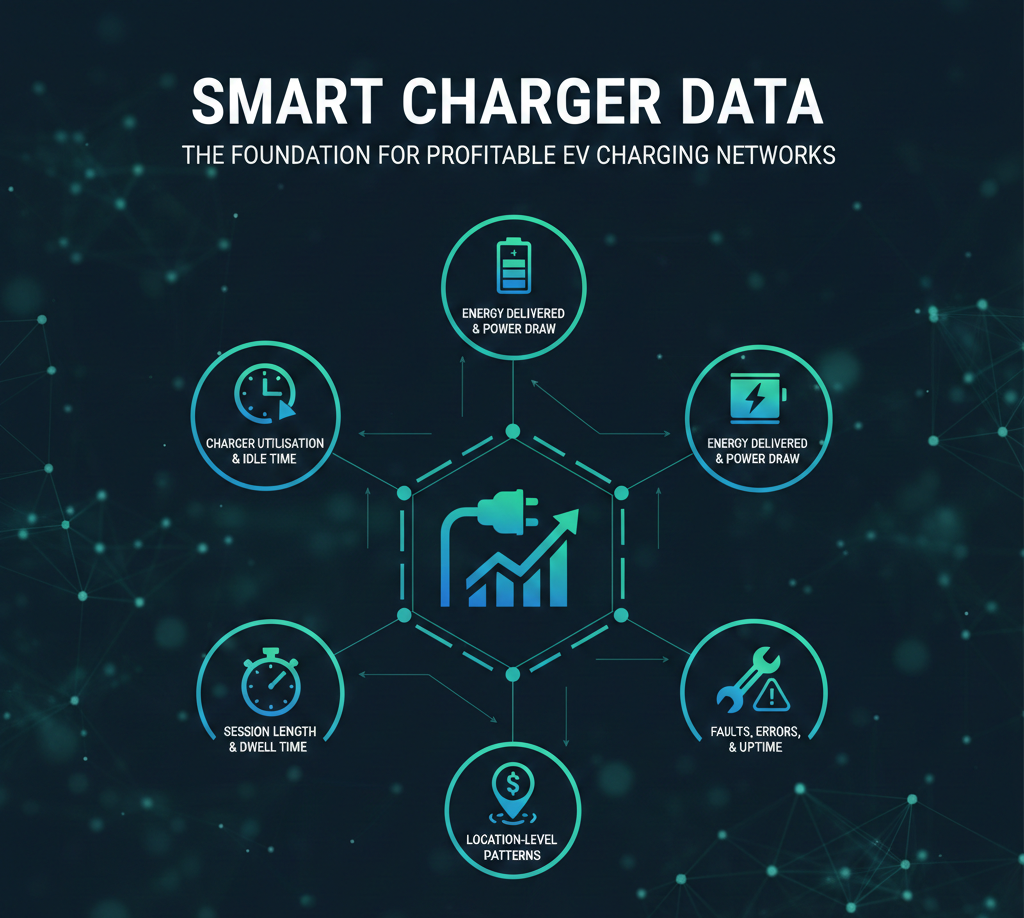
Smart charger data is the real-time and historical operational data generated by EV chargers that shows how chargers are used, how they perform, and how demand changes over time.
This data includes:
- Charger utilisation and idle time
- Energy delivered and power draw
- Session length and dwell time
- Faults, errors, and uptime
- Location-level demand patterns
Smart charger data is the foundation for making EV charging networks profitable.
Why Smart Charger Data Matters for EV Charging Profitability
Most EV charging networks don’t struggle because of lack of demand. They struggle because demand is uneven, unmanaged, and poorly priced.
Without smart data:
- Chargers sit idle in some locations
- Other sites face congestion and queues
- Downtime goes unnoticed until users complain
- Expansion decisions are based on assumptions
Smart charger data turns charging networks from reactive operations into controlled, optimised systems.
How Smart Charger Data Improves Charger Utilisation
Charger utilisation measures how often a charger is actually used compared to how long it is available.
Using smart charger data, operators can:
- Identify underutilised chargers and locations
- Detect congestion and overuse at high-demand sites
- Match charger type (AC vs DC) to real usage
- Adjust pricing and visibility to balance load
Higher utilisation increases revenue per charger without adding new hardware.
How Smart Charger Data Enables Smarter, Revenue-Positive Pricing
Smart charger data helps operators price to reduce friction and improve throughput, not just increase tariffs.
With real usage and dwell-time data, networks can:
- Prevent congestion before it affects user experience
Adjust pricing when chargers are being blocked longer than intended. - Improve charger turnover at busy locations
Use session-length data to discourage overstays at fast chargers. - Activate underutilised chargers automatically
Lower tariffs during low-demand periods to convert idle capacity into revenue. - Optimise pricing at the site level
Price differently for highways, urban hubs, offices, and residential locations based on actual usage. - Protect margins against energy and operational costs
Align tariffs with real power demand and site-level expenses.
How Smart Charger Data Reduces Downtime and Revenue Loss
Downtime is one of the biggest hidden revenue drains in EV charging networks.
Smart charger data enables:
- Early detection of recurring faults
- Predictive maintenance before chargers fail
- Remote diagnostics and faster resolution
- Higher uptime and reliability
Higher uptime directly leads to more charging sessions and improved user trust.
How Smart Charger Data Guides Smarter Network Expansion
Installing chargers without usage data increases the risk of stranded or low-performing assets.
With historical and real-time data, operators can:
- Identify where demand is consistently growing
- Decide when AC chargers should be upgraded to DC
- Expand power capacity only when utilisation justifies it
- Avoid overbuilding at low-demand locations
Data-led expansion improves capital efficiency and return on investment.
How Smart Charger Data Improves Customer Retention
Charging reliability and predictability drive repeat usage.
Smart charger data helps operators:
- Identify repeat users and high-value locations
- Improve uptime at critical sites
- Design pricing and loyalty programs around real behaviour
- Reduce failed sessions and charging anxiety
Better experience leads to higher lifetime value per user.
Can Smart Charger Data Create New Revenue Streams?
Yes. Smart charger data can be monetised beyond charging transactions.
Additional opportunities include:
- Fleet analytics and usage reporting
- Partnerships with retail and real estate operators
- Grid services such as load balancing and demand response
As EV adoption grows, charging networks with high-quality data become valuable ecosystem partners.
How IONAGE Turns Smart Charger Data into Profitable Action
IONAGE is an EV charging orchestration platform that converts smart charger data into operational and revenue-driven decisions.
IONAGE enables operators to:
- Monitor and store charger utilisation and health across time
- Analyse usage trends to optimise pricing and load planning
- Reduce downtime through proactive fault detection and alerts
- Manage multi-OEM charger networks from a single platform
- Plan expansion using historical usage insights, not assumptions
Instead of just visualising data, IONAGE helps charging networks act on it, turning insights into measurable outcomes.
What Is the Future of Profitable EV Charging Networks?
The future of EV charging profitability is data-first, optimised, and orchestrated.
Winning networks will:
- Focus on utilisation before expansion
- Use pricing to balance demand, not guess it
- Minimise downtime through predictive operations
- Treat charger data as a core business asset
Smart charger data already exists across your network.
Profitability depends on how effectively it is used.
Your chargers are already generating data. The opportunity lies in using it better.
Talk to our sales team to see how IONAGE can help turn your charging network into a profit engine.
As the world shifts gears toward a more sustainable future, the way we drive is changing—fast. Are you in the market for an EV? In your research, you might have come across different EV and Hybrid technologies from various manufacturers. Was it confusing or complex? We are here to de-mystify and help in your decision.
No worries—we’re here to break it down! Let’s explore the key differences between Electric Vehicles (EVs) and Hybrid Vehicles, so you can make the right choice.
What is the deal with electric vehicles (EV’s)
Electric vehicles run purely on electricity and are powered by rechargeable batteries that run the electric motor. That’s it. Here are a few reasons that give EVs an unfair advantage:
- Modern Design and Ownership: EVs have changed the fundamentals of the vehicle. You see a much more modern aesthetic and design for EVs. Additionally, this helps EV manufacturers develop innovative ways of ownership such as the MG Windsor.
- Lower Running Costs: The charge per kilometer for EVs is much lower than running on gas. Also, fewer running parts mean lesser maintenance.
- Eco-Friendly: With zero emissions, EVs are cleaner and quieter than traditional cars, contributing to reduced pollution and better air quality. Good for the planet, good for your lungs!
But it’s not all sunshine and supercharging. EVs do have some limits, especially when it comes to range. Currently, You’ll need to plan ahead if you’re going on a long road trip, but hey—that’s what apps and fast chargers are for! Then there is the question of batteries.
The Hybrid Vehicle: Best of Both Worlds?
If you're not ready to go fully electric yet, the next available option is a hybrid Vehicle. A hybrid vehicle uses a combination of gasoline and electric power to drive the vehicle. Hybrid technologies are considered a great intermediate step before the grand march toward a fully EV world. This makes them easy to recommend.
Here’s why a Hybrid Vehicle might be considered:
- Better Fuel Efficiency: Since hybrids can use electricity to supplement gasoline, they use less fuel overall—making them more efficient than traditional gas-powered cars.
- Extended Range: Worried about running out of charge? Hybrids still have gasoline backup, so you can go the distance without range anxiety.
- Familiarity: between EV and ICE, Hybrids feel like traditional fuel-powered cars but add a sustainable twist. It's just like an extension of an ICE.
Before pegging on the Hybrid Vehicle, consider the following.
- Space and Design: Hybrid Vehicles need to have batteries as well as a combustion engine. This greatly reduces space efficiency. Big boxes for the next adventure would be difficult to fit. They are also not as quiet as EVs. The design tends to be closer to traditional automotive without the advantages of the modern EV experience.
- Extended Range: Worried about running out of charge? Hybrids still have gasoline backup, so you can go the distance without range anxiety.
- Familiarity: between EV and ICE, Hybrids feel like traditional fuel-powered cars but add a sustainable twist. It's just like an extension of an ICE.
Still, for those who aren’t ready to take the full EV plunge, hybrids offer a solid first step.
Which One Should You Choose?
Ultimately, deciding between an EV and a Hybrid Vehicle comes down to your lifestyle and driving needs.
- If you’re all about cutting emissions and want the latest tech with the lowest environmental impact, go electric. You’ll be doing your part to keep the planet green while enjoying cutting-edge innovation.
- If you’re not ready to give up the flexibility of gasoline but still want to reduce your carbon footprint, a hybrid might be the perfect compromise.
At Ionage Technologies, we believe in the power of choice—because there’s no one-size-fits-all answer when it comes to sustainable driving. Whether you choose a full EV or a hybrid, both options represent a step toward a cleaner, smarter future.
Wrapping it up: the road ahead
As EV charging infrastructure grows and technology improves, the gap between electric and hybrid vehicles is closing fast. More people are embracing electric mobility, and the future looks bright. Whichever path you choose, it’s clear that sustainable mobility is the destination.
Ready to make your move? Join us on the journey to electrify the roads and drive toward a greener tomorrow.