In This Blog
Get tips, updates & exclusives—no spam


BLOGS
How to Choose the Right EV Charging Software for Your Business
Destination Charging

How to Choose the Right EV Charging Software for Your Business
The electric vehicle (EV) ecosystem in India is growing faster than ever. According to the Ministry of Heavy Industries, India crossed 4.4 million registered EVs in 2024, and the number of public charging stations grew by five times in last three years. NITI Aayog projects that by 2030, more than 30 percent of all vehicles sold in India will be electric, creating an urgent need for reliable and scalable charging infrastructure.
But while chargers are being installed rapidly, software is what makes this infrastructure work. Without the right management platform, operators struggle to monitor chargers, manage payments, or provide drivers with a smooth experience. As networks expand, these challenges multiply, leading to downtime, customer frustration, and lost revenue.
That is why EV charging software has become the backbone of India’s mobility transition. It enables businesses to remotely manage stations, optimize energy use, and deliver seamless charging experiences at scale.
This guide explores what to look for when selecting EV charging software for your business, the common pitfalls to avoid, and how future-ready platforms like Ionage are setting the benchmark for next-generation EV operations in India.
1. The Shift to Software-First EV Charging Networks
A few years ago, the focus for most EV companies was hardware: installing chargers, expanding coverage, and ensuring uptime. But today, success depends on software intelligence.
A modern charging management system (CMS) goes beyond turning chargers on and off. It powers an entire ecosystem by enabling you to:
- Monitor station performance and uptime remotely
- Set dynamic tariffs and track revenue
- Integrate with driver apps and fleet management systems
- Offer digital payments and smart energy insights
- Analyze data to optimize network utilization
Without a robust software backbone, networks become fragmented, operational costs increase, and customer experience suffers.
That is why software-first operations are becoming the norm, enabling CPOs, OEMs, and fleets to build scalable, intelligent, and sustainable networks.
2. Why Choosing the Right Software Matters
Your software is not just a management tool; it is your operational core.
A well-chosen EV charging platform empowers you to:
- Scale efficiently: Grow from a few stations to thousands without retooling your system
- Stay interoperable: Connect chargers, payment systems, and energy sources with minimal friction
- Simplify operations: Automate workflows and minimize manual monitoring
- Enhance user experience: Provide EV drivers with a seamless and reliable experience
Choosing the wrong software, on the other hand, can lead to downtime, complex integrations, vendor lock-ins, and poor data visibility, all of which slow your growth and hurt profitability.
3. Key Factors to Evaluate Before You Decide
Before committing to any platform, assess it across these essential dimensions.
a. Scalability and Network Flexibility
Your charging software should grow with your business. Whether you operate 10 chargers or 10,000, scalability ensures smooth expansion without disruption.
Look for systems that support:
- Multiple charger models (AC, DC, fast and slow)
- Various deployment types (home, public, commercial, fleet)
- Multi-region operations from a single dashboard
Scalable platforms allow you to onboard chargers quickly and manage all assets centrally.
b. Interoperability and Open Protocols
Interoperability ensures freedom of choice and network compatibility.
Choose software built on open standards like OCPP (Open Charge Point Protocol) and OCPI (Open Charge Point Interface). These enable your chargers to work with multiple vendors, roaming partners, and mobility service providers without costly reconfiguration.
This flexibility protects you from vendor lock-ins and future-proofs your network as new technologies and business models emerge.
c. Integration Capabilities
EV charging does not happen in isolation. Your software should integrate seamlessly into your wider business systems.
Look for platforms that easily connect with:
- Payment gateways: UPI, cards, digital wallets
- Fleet management systems: For energy tracking and driver coordination
- Energy monitoring tools: To manage power distribution and optimize grid usage
- OEM and mobile apps: For a unified customer experience
A developer-friendly ecosystem with APIs and SDKs ensures smoother integrations and faster innovation.
d. User Experience for Drivers
EV adoption depends heavily on the driver experience. A simple, intuitive, and reliable app builds loyalty and usage consistency.
The ideal driver interface should enable:
- Easy charger discovery with filters for location, power type, and availability
- One-tap payments via digital wallets or UPI
- Transparent session tracking, receipts, and energy reports
- Unified access to both home and public charging networks
Every charging session is a customer interaction. A frictionless user experience directly translates into higher charger utilization and stronger brand trust.
e. Data Insights and Reporting
Data is your most valuable asset in an EV business.
A powerful analytics module should offer:
- Real-time charger performance and uptime data
- Predictive maintenance alerts to reduce downtime
- Utilization metrics for each site and asset
- Revenue tracking and cost-per-session analytics
Advanced insights also help with expansion planning, identifying underperforming sites, and predicting future demand.
Some platforms now integrate sustainability metrics, showing how much CO2 was saved or how much solar energy was used, a valuable addition for ESG reporting.
f. Cost and Monetization Capabilities
Software pricing should be transparent and scalable.
Look for built-in monetization tools like:
- Subscriptions and membership models
- Pay-per-use or session-based billing
- Fleet billing and reconciliation
Avoid platforms that charge hidden fees for scaling or API access. Such costs often accumulate as your network grows. A clear pricing model ensures predictable ROI and financial sustainability.
g. Localisation and Compliance
Operating in India means your software should align with Indian payment systems, policies, and standards.
Ensure your platform supports:
- UPI and wallet-based transactions
- GST-compliant invoicing and receipts
- Adaptability to state-level EV policies and power tariffs
Localisation is not just about payments; it is about ensuring smooth regulatory compliance and faster market readiness.
4. Common Mistakes Businesses Make
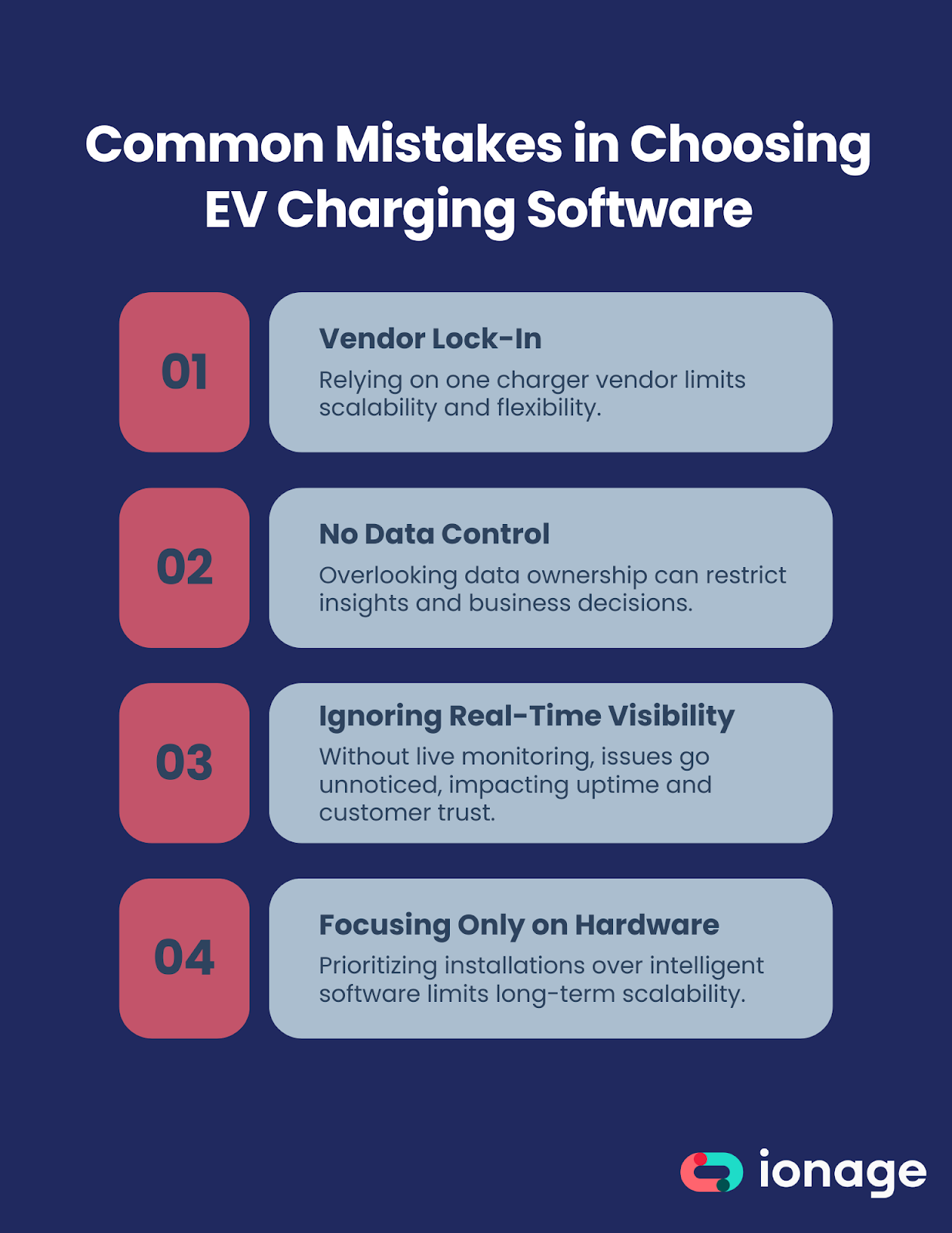
Many operators, especially new entrants, fall into the same traps when choosing EV charging software.
Here is what to avoid:
- Choosing a platform tied to one charger vendor
- Ignoring data ownership clauses
- Overlooking fleet and home charging integration
- Not planning for renewable energy integration or future-proofing
- Focusing Only on Hardware
These mistakes can slow your expansion, complicate operations, and erode profitability.
5. Future-Ready Capabilities to Look For
The EV ecosystem is shifting rapidly. The best software is not just built for today; it is built for the next five years.
Here is what forward-thinking CPOs and OEMs should prioritize:
- Solar and green energy integration (for example, Ionage Casa’s digital solar credits)
- Fleet marketplace connectivity (Ionage Flo for CPO-fleet partnerships)
- Smart charging features such as load management, predictive maintenance, and dynamic tariffs
- Developer-friendly ecosystem for OEMs and app partners
Choosing software that evolves with technology ensures you remain competitive in an increasingly smart, data-driven landscape.
6. How Ionage Helps Businesses Make the Right Choice
Ionage is redefining what EV charging software means in India. Instead of being a single product, Ionage offers an end-to-end ecosystem built for scalability, interoperability, and growth.
Here is how it helps every layer of the EV ecosystem:
- Ionage Nexus - A full-stack network management system for CPOs to monitor, manage, and monetize their chargers with real-time analytics.
- Ionage Flux - A unified driver app that aggregates public and private charging, offers digital payments, and provides detailed session tracking.
- Ionage Flo - A fleet and CPO marketplace platform that simplifies partnerships and dynamic contract management.
- Ionage Casa - A smart home charging solution that supports solar integration, remote monitoring, and charger-agnostic compatibility.
Key Differentiators:
- Pre-built integrations with eMSP and OEM partners
- Scalable and charger-agnostic architecture
- Compliance with Indian standards, including UPI, GST, and energy regulations
- Unified experience across home, public, and fleet charging
- Competitive pricing with premium reliability and support
Ionage’s ecosystem-centric approach makes it uniquely positioned to help businesses scale smartly while maintaining full control over their data and operations.
7. Conclusion: Building a Future-Ready EV Charging Network
The right EV charging software does not just manage chargers; it manages your growth.
As India accelerates toward widespread EV adoption, CPOs, OEMs, and fleets need technology that scales, integrates, and adapts. From real-time analytics and open protocols to local compliance and green energy readiness, the future belongs to software-driven networks that connect every part of the charging ecosystem.
Whether you are building a public charging network, managing fleet operations, or enabling home charging solutions, the principles remain the same: choose a platform that grows with you, not one that limits you.
And that is exactly what Ionage enables: a unified, future-ready EV ecosystem built for India’s next generation of mobility.
As the world shifts gears toward a more sustainable future, the way we drive is changing—fast. Are you in the market for an EV? In your research, you might have come across different EV and Hybrid technologies from various manufacturers. Was it confusing or complex? We are here to de-mystify and help in your decision.
No worries—we’re here to break it down! Let’s explore the key differences between Electric Vehicles (EVs) and Hybrid Vehicles, so you can make the right choice.
What is the deal with electric vehicles (EV’s)
Electric vehicles run purely on electricity and are powered by rechargeable batteries that run the electric motor. That’s it. Here are a few reasons that give EVs an unfair advantage:
- Modern Design and Ownership: EVs have changed the fundamentals of the vehicle. You see a much more modern aesthetic and design for EVs. Additionally, this helps EV manufacturers develop innovative ways of ownership such as the MG Windsor.
- Lower Running Costs: The charge per kilometer for EVs is much lower than running on gas. Also, fewer running parts mean lesser maintenance.
- Eco-Friendly: With zero emissions, EVs are cleaner and quieter than traditional cars, contributing to reduced pollution and better air quality. Good for the planet, good for your lungs!
But it’s not all sunshine and supercharging. EVs do have some limits, especially when it comes to range. Currently, You’ll need to plan ahead if you’re going on a long road trip, but hey—that’s what apps and fast chargers are for! Then there is the question of batteries.
The Hybrid Vehicle: Best of Both Worlds?
If you're not ready to go fully electric yet, the next available option is a hybrid Vehicle. A hybrid vehicle uses a combination of gasoline and electric power to drive the vehicle. Hybrid technologies are considered a great intermediate step before the grand march toward a fully EV world. This makes them easy to recommend.
Here’s why a Hybrid Vehicle might be considered:
- Better Fuel Efficiency: Since hybrids can use electricity to supplement gasoline, they use less fuel overall—making them more efficient than traditional gas-powered cars.
- Extended Range: Worried about running out of charge? Hybrids still have gasoline backup, so you can go the distance without range anxiety.
- Familiarity: between EV and ICE, Hybrids feel like traditional fuel-powered cars but add a sustainable twist. It's just like an extension of an ICE.
Before pegging on the Hybrid Vehicle, consider the following.
- Space and Design: Hybrid Vehicles need to have batteries as well as a combustion engine. This greatly reduces space efficiency. Big boxes for the next adventure would be difficult to fit. They are also not as quiet as EVs. The design tends to be closer to traditional automotive without the advantages of the modern EV experience.
- Extended Range: Worried about running out of charge? Hybrids still have gasoline backup, so you can go the distance without range anxiety.
- Familiarity: between EV and ICE, Hybrids feel like traditional fuel-powered cars but add a sustainable twist. It's just like an extension of an ICE.
Still, for those who aren’t ready to take the full EV plunge, hybrids offer a solid first step.
Which One Should You Choose?
Ultimately, deciding between an EV and a Hybrid Vehicle comes down to your lifestyle and driving needs.
- If you’re all about cutting emissions and want the latest tech with the lowest environmental impact, go electric. You’ll be doing your part to keep the planet green while enjoying cutting-edge innovation.
- If you’re not ready to give up the flexibility of gasoline but still want to reduce your carbon footprint, a hybrid might be the perfect compromise.
At Ionage Technologies, we believe in the power of choice—because there’s no one-size-fits-all answer when it comes to sustainable driving. Whether you choose a full EV or a hybrid, both options represent a step toward a cleaner, smarter future.
Wrapping it up: the road ahead
As EV charging infrastructure grows and technology improves, the gap between electric and hybrid vehicles is closing fast. More people are embracing electric mobility, and the future looks bright. Whichever path you choose, it’s clear that sustainable mobility is the destination.
Ready to make your move? Join us on the journey to electrify the roads and drive toward a greener tomorrow.