In This Blog
Get tips, updates & exclusives—no spam


BLOGS
NMC vs LFP Batteries: Which EV Battery Is Better for India?
Featured

NMC vs LFP Batteries: Which EV Battery Is Better for India?
When choosing an electric vehicle, most buyers look at range, charging speed, features and price. But there is another factor that plays a major role in how an EV performs over time: the battery chemistry.
Two of the most common lithium-ion battery chemistries used in EVs are NMC (Nickel Manganese Cobalt) and LFP (Lithium Iron Phosphate).
Both have their advantages. NMC batteries offer higher energy density, making them well suited for long-range and performance-focused EVs. LFP batteries, on the other hand, are known for their durability, thermal stability and longer cycle life.
So, NMC vs LFP: which one is better for India?
The answer depends on what you expect from your EV.
What Is an NMC Battery?
NMC stands for Nickel Manganese Cobalt.
NMC is a lithium-ion battery chemistry that offers high energy density. This means manufacturers can store more energy without making the battery pack excessively large or heavy.
For EVs, that can translate into higher range and better performance without adding too much weight.
This is one reason NMC batteries are commonly associated with premium and long-range electric vehicles.
Advantages of NMC Batteries
1. Higher energy density
More energy can be stored in a relatively compact battery pack.
2. Higher range potential
A higher energy density can help EV manufacturers offer longer driving ranges.
3. Lower battery weight
For the same energy capacity, an NMC pack can generally be lighter than an LFP pack.
4. Strong performance
NMC chemistry can deliver the power required for performance-oriented applications.
Limitations of NMC Batteries
1. Higher cost
NMC batteries generally cost more because of their material composition.
2. Uses nickel and cobalt
These materials can increase cost and raise supply-chain and sustainability considerations.
3. Generally shorter cycle life
Compared with LFP, NMC batteries typically have a lower cycle-life advantage.
4. Greater thermal-management requirements
Effective battery cooling and management are important for maintaining safety and performance.
Where Does NMC Make Sense?
NMC can be particularly suitable for:
- Long-range electric cars
- Premium EVs
- Performance-focused EVs
- Highway-focused vehicles
- Applications where lower weight is important
What is an LFP Battery?
LFP stands for Lithium Iron Phosphate.
LFP is another lithium-ion battery chemistry, but instead of nickel and cobalt, it uses lithium iron phosphate as its cathode material.
Its biggest strengths are durability, thermal stability and cycle life.
While LFP batteries generally have lower energy density than NMC, they can be an attractive option when an EV is expected to be used frequently and charged regularly.
Advantages of LFP Batteries
1. Longer cycle life
LFP batteries can typically withstand more charge-discharge cycles.
2. Better thermal stability
LFP chemistry is generally more thermally stable than NMC.
3. Lower cost
The chemistry avoids nickel and cobalt, which can help reduce battery costs.
4. Good for frequent charging
Its cycle-life characteristics make LFP well suited to vehicles that are used heavily.
Limitations of LFP Batteries
1. Lower energy density
More battery material may be needed to store the same amount of energy.
2. Higher weight
An LFP battery pack can be heavier for an equivalent capacity.
3. Lower performance in cold conditions
LFP batteries can experience greater performance limitations at low temperatures.
4. Potentially lower range for the same pack size
Because of its lower energy density, achieving the same range may require a larger battery pack.
Where Does LFP Make Sense?
LFP can be particularly suitable for:
- City EVs
- Electric taxis
- Commercial vehicles
- Electric buses
- Delivery fleets
- High-utilisation EVs
- Mass-market electric cars
NMC vs LFP: What's the Difference?
Here's a simple comparison:
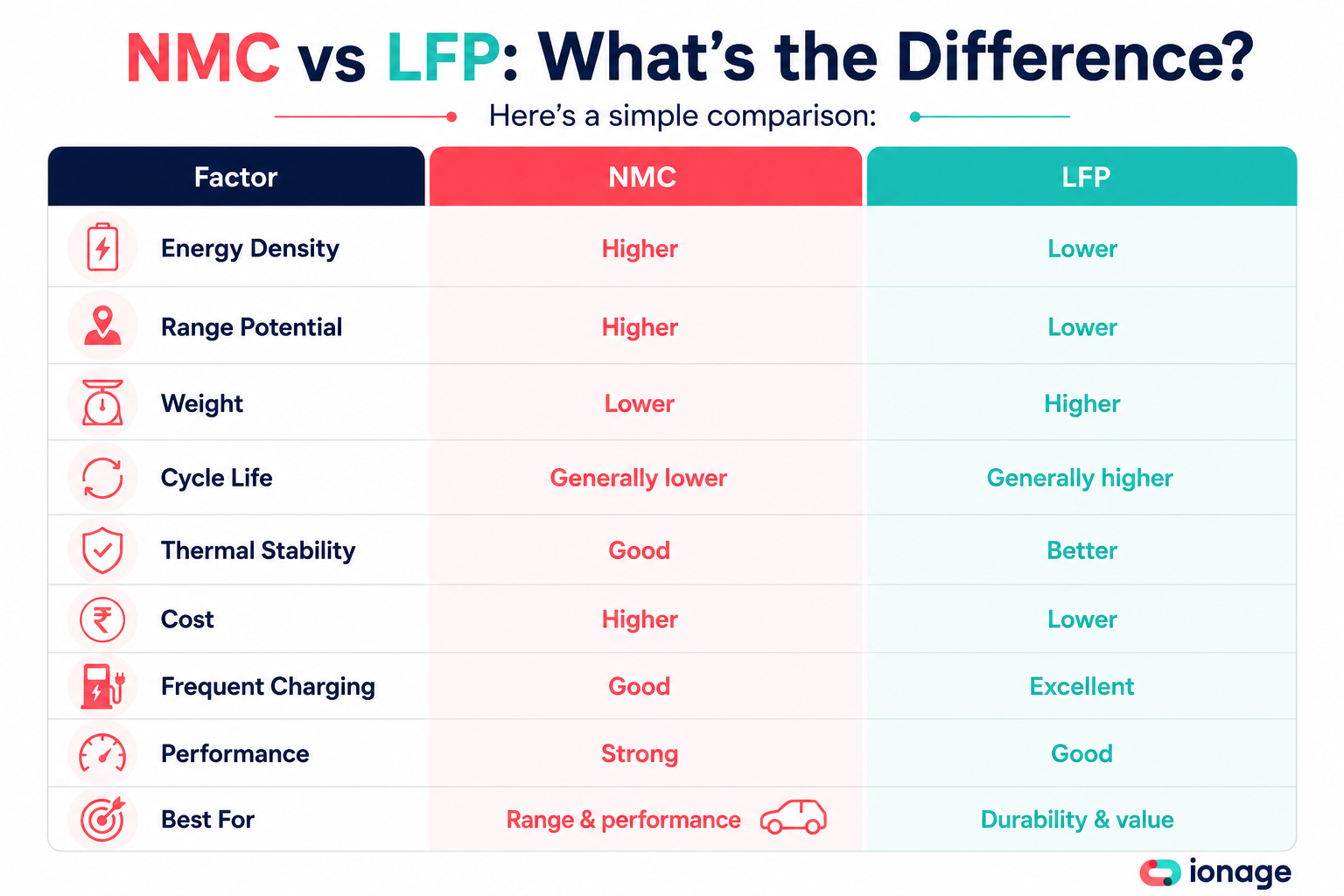
Neither chemistry wins in every category.
The better choice depends on what you value most.
NMC vs LFP: Which Battery Is Safer?
Battery safety is one of the biggest concerns for EV buyers.
Both NMC and LFP batteries can be safe when they are properly designed, manufactured and managed. However, their chemistry gives them different thermal characteristics.
NMC Batteries
NMC batteries generally require effective thermal management because they can be more susceptible to thermal runaway under severe conditions.
A well-designed battery pack therefore needs appropriate:
- Thermal management
- Battery Management System (BMS)
- Cell protection
- Charging controls
- Monitoring systems
LFP Batteries
LFP chemistry has better thermal stability and is generally more resistant to thermal runaway than NMC.
This makes LFP attractive for applications where vehicles are heavily used or operate in demanding conditions.
However, an important point is often missed:
LFP batteries are not fire-proof.
A battery fire can still occur because of factors such as physical damage, manufacturing defects, electrical faults, overcharging or failures in battery protection systems.
The chemistry is only one part of battery safety.
Battery-pack design, BMS, thermal management, manufacturing quality and charging systems all matter.
Why Does This Matter in India?
India presents some unique conditions for EVs.
1. High Temperatures
Many parts of India experience high ambient temperatures, especially during summer.
Battery thermal management therefore becomes particularly important.
LFP's stronger thermal stability can make it attractive for these conditions.
2. Heavy Traffic
Urban EVs often spend significant time in stop-and-go traffic.
For vehicles that are driven daily, durability and efficient energy management become important.
3. Frequent Charging
A vehicle that travels long distances every day may need to be charged frequently.
This makes cycle life an important consideration, particularly for taxis, fleets and commercial vehicles.
4. Long-Distance Travel
For highway travel, range can become the bigger priority.
This is where NMC's higher energy density can provide an advantage by allowing manufacturers to offer greater range without dramatically increasing battery weight.
5. Affordability
Battery cost has a significant impact on the overall cost of an EV.
LFP's chemistry can offer a cost advantage, making it attractive for more affordable and high-volume EV applications.
Which Battery Is Better for India?
There isn't one answer for every Indian EV buyer.
Instead, think about how you use your vehicle.
Choose NMC if you prioritise:
1. More range
If you regularly travel long distances, NMC's higher energy density can be valuable.
2. Lower weight
A lighter battery can contribute to vehicle efficiency and performance.
3. Performance
For drivers looking for stronger performance, NMC can be a better fit.
4. Highway driving
Long-distance drivers may benefit from the higher range potential.
Choose LFP if you prioritise:
1. Daily city driving
For regular commuting, LFP can offer a practical balance of cost and durability.
2. Frequent charging
Its longer cycle life makes it well suited to vehicles that charge often.
3. High daily utilisation
Taxis, fleets and commercial vehicles can benefit from its durability.
4. Long-term value
Lower battery cost and longer cycle life can make LFP attractive from a total-cost-of-ownership perspective.
5. Thermal stability
For applications where thermal stability is a major consideration, LFP has an advantage.
NMC vs LFP for EV Fleets
The battery decision becomes even more important for commercial EV fleets.
A personal car may travel a few dozen kilometres a day. A taxi, delivery vehicle or commercial fleet vehicle can travel significantly more.
That means fleet operators need to think about:
- Daily kilometres
- Charging frequency
- Battery degradation
- Vehicle downtime
- Operating costs
- Total cost of ownership
For these applications, LFP can make a particularly strong case because of its cycle life, thermal stability and cost advantages.
For fleets where maximum range and vehicle weight are critical, however, NMC can still be the better option.
Does Battery Chemistry Affect EV Charging?
Yes, but it isn't the only factor.
Battery chemistry can influence charging behaviour, temperature and how the battery responds to repeated charging.
However, charging speed isn't determined by battery chemistry alone.
It also depends on:
- Battery capacity
- Battery Management System
- Thermal management
- Charger power
- Charging curve
- Vehicle architecture
- State of charge
- Battery temperature
For example, two EVs using the same battery chemistry can still have very different charging speeds.
That's why it's important to look beyond simply asking whether an EV uses NMC or LFP.
How Can You Extend Your EV Battery Life?
Regardless of whether your EV uses NMC or LFP, good charging and driving habits can help maintain battery health.
Follow the manufacturer's charging recommendations
Your vehicle manufacturer knows the battery's recommended operating range and charging practices.
Avoid excessive heat
Extreme temperatures can put additional stress on batteries. Proper thermal management is essential.
Use compatible charging equipment
Always use appropriate charging equipment and follow the manufacturer's recommendations.
Avoid unnecessary deep discharge
Regularly running the battery extremely low can put additional stress on the battery.
Don't ignore battery warnings
If the vehicle reports a battery or charging-system issue, get it checked rather than continuing to use it normally.
NMC vs LFP: Which One Should You Choose?
The simplest way to look at it is:
NMC = Range + Weight + Performance
LFP = Durability + Thermal Stability + Value
If you want a long-range, lightweight and performance-focused EV, NMC can be an excellent choice.
If you want an EV for daily driving, frequent charging, fleet operations or high utilisation, LFP can be a more practical option.
For many Indian mass-market and high-utilisation applications, LFP has a strong case.
But that doesn't make NMC outdated or inferior.
The right battery depends on how the vehicle is designed and how you use it.
The Right Battery Still Needs the Right Charging Experience
Choosing the right battery is only one part of owning an EV.
You also need a reliable and convenient way to charge it.
Whether you're driving across the city or planning a long-distance road trip, finding the right charger shouldn't mean switching between multiple apps and charging networks.
That's where IONAGE comes in.
IONAGE brings multiple EV charging networks together in one app, helping EV drivers find chargers and make charging simpler.
Drive electric. Charge smarter.
IONAGE: One app. Multiple charging networks.
Frequently Asked Questions
1. Which is better, NMC or LFP battery?
Neither is universally better. NMC is better suited for higher range, lower weight and performance, while LFP is better suited for durability, thermal stability, frequent charging and cost efficiency.
2. Is LFP safer than NMC?
LFP generally offers better thermal stability and a lower risk of thermal runaway compared with NMC. However, no lithium-ion battery is completely fire-proof. Battery design, BMS and thermal management also play a major role in safety.
3. Which battery lasts longer, NMC or LFP?
LFP batteries generally have a longer cycle life than NMC batteries, making them particularly suitable for vehicles that are driven and charged frequently.
4. Which battery is better for Indian conditions?
LFP can be a practical choice for many Indian use cases because of its thermal stability, durability and cost advantages. NMC can be better for EVs where long range, lower weight and performance are the priorities.
As the world shifts gears toward a more sustainable future, the way we drive is changing—fast. Are you in the market for an EV? In your research, you might have come across different EV and Hybrid technologies from various manufacturers. Was it confusing or complex? We are here to de-mystify and help in your decision.
No worries—we’re here to break it down! Let’s explore the key differences between Electric Vehicles (EVs) and Hybrid Vehicles, so you can make the right choice.
What is the deal with electric vehicles (EV’s)
Electric vehicles run purely on electricity and are powered by rechargeable batteries that run the electric motor. That’s it. Here are a few reasons that give EVs an unfair advantage:
- Modern Design and Ownership: EVs have changed the fundamentals of the vehicle. You see a much more modern aesthetic and design for EVs. Additionally, this helps EV manufacturers develop innovative ways of ownership such as the MG Windsor.
- Lower Running Costs: The charge per kilometer for EVs is much lower than running on gas. Also, fewer running parts mean lesser maintenance.
- Eco-Friendly: With zero emissions, EVs are cleaner and quieter than traditional cars, contributing to reduced pollution and better air quality. Good for the planet, good for your lungs!
But it’s not all sunshine and supercharging. EVs do have some limits, especially when it comes to range. Currently, You’ll need to plan ahead if you’re going on a long road trip, but hey—that’s what apps and fast chargers are for! Then there is the question of batteries.
The Hybrid Vehicle: Best of Both Worlds?
If you're not ready to go fully electric yet, the next available option is a hybrid Vehicle. A hybrid vehicle uses a combination of gasoline and electric power to drive the vehicle. Hybrid technologies are considered a great intermediate step before the grand march toward a fully EV world. This makes them easy to recommend.
Here’s why a Hybrid Vehicle might be considered:
- Better Fuel Efficiency: Since hybrids can use electricity to supplement gasoline, they use less fuel overall—making them more efficient than traditional gas-powered cars.
- Extended Range: Worried about running out of charge? Hybrids still have gasoline backup, so you can go the distance without range anxiety.
- Familiarity: between EV and ICE, Hybrids feel like traditional fuel-powered cars but add a sustainable twist. It's just like an extension of an ICE.
Before pegging on the Hybrid Vehicle, consider the following.
- Space and Design: Hybrid Vehicles need to have batteries as well as a combustion engine. This greatly reduces space efficiency. Big boxes for the next adventure would be difficult to fit. They are also not as quiet as EVs. The design tends to be closer to traditional automotive without the advantages of the modern EV experience.
- Extended Range: Worried about running out of charge? Hybrids still have gasoline backup, so you can go the distance without range anxiety.
- Familiarity: between EV and ICE, Hybrids feel like traditional fuel-powered cars but add a sustainable twist. It's just like an extension of an ICE.
Still, for those who aren’t ready to take the full EV plunge, hybrids offer a solid first step.
Which One Should You Choose?
Ultimately, deciding between an EV and a Hybrid Vehicle comes down to your lifestyle and driving needs.
- If you’re all about cutting emissions and want the latest tech with the lowest environmental impact, go electric. You’ll be doing your part to keep the planet green while enjoying cutting-edge innovation.
- If you’re not ready to give up the flexibility of gasoline but still want to reduce your carbon footprint, a hybrid might be the perfect compromise.
At Ionage Technologies, we believe in the power of choice—because there’s no one-size-fits-all answer when it comes to sustainable driving. Whether you choose a full EV or a hybrid, both options represent a step toward a cleaner, smarter future.
Wrapping it up: the road ahead
As EV charging infrastructure grows and technology improves, the gap between electric and hybrid vehicles is closing fast. More people are embracing electric mobility, and the future looks bright. Whichever path you choose, it’s clear that sustainable mobility is the destination.
Ready to make your move? Join us on the journey to electrify the roads and drive toward a greener tomorrow.