In This Blog
Get tips, updates & exclusives—no spam


BLOGS
Top 10 EV Charging Problems in India And How to Fix Them
Ev Charging
Featured
Top 10 EV Charging Problems in India And How to Fix Them
India’s electric mobility movement is gaining momentum. EV adoption is accelerating due to falling battery costs, strong government incentives, and growing environmental awareness. However, despite this growth, charging remains a key challenge for drivers.
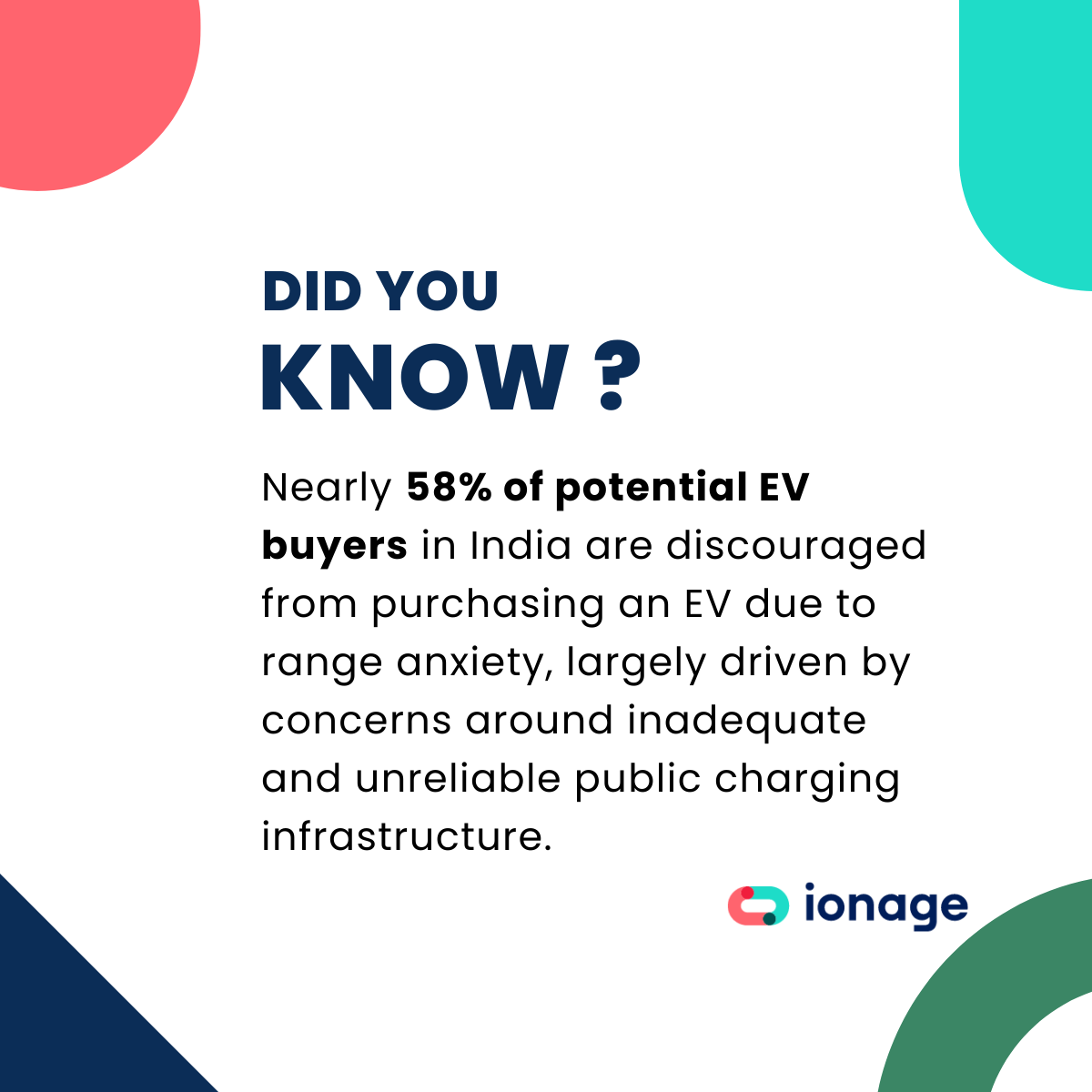
From broken chargers and slow speeds to confusing apps and unpredictable pricing, the EV charging experience in India still has several pain points. In fact, nearly 58% of potential EV buyers in India are discouraged from purchasing an EV due to range anxiety, largely driven by concerns around inadequate and unreliable public charging infrastructure.
In this blog, we break down the top 10 EV charging problems in India and explore practical, real-world solutions to make charging more reliable, predictable, and stress-free.
1. Charger Downtime and Poor Reliability
One of the most frustrating experiences for EV drivers is arriving at a charging station only to find it offline, faulty, or unavailable.
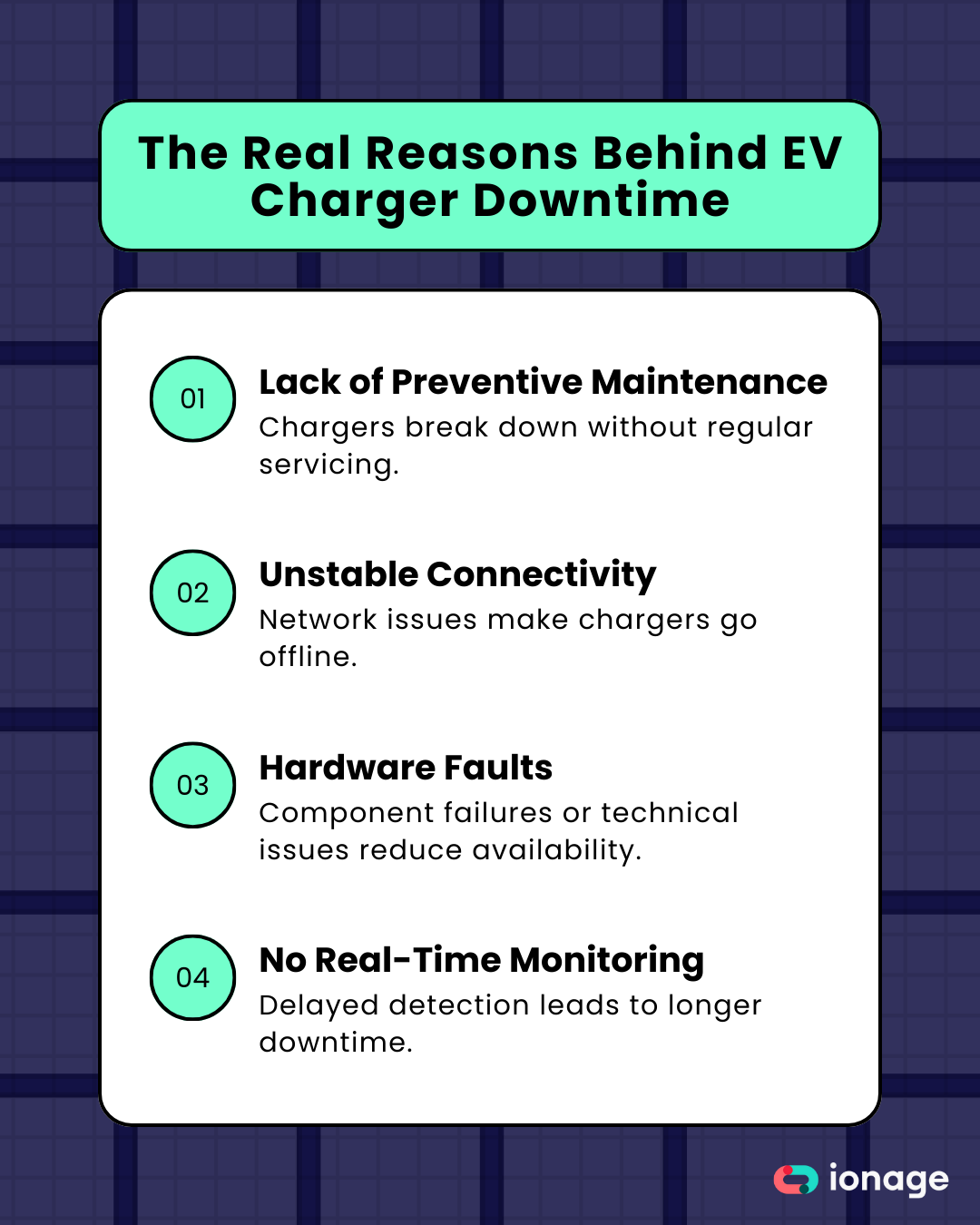
Causes of downtime include:
- Lack of preventive maintenance
- Unstable connectivity
- Hardware faults
- No real-time monitoring
Impact on EV drivers: Downtime leads to range anxiety and wasted trips, especially when chargers are sparse.
Solutions:
- Implement preventive and predictive maintenance
- Deploy IoT-enabled chargers for live status updates
- Use monitoring dashboards for operators
- Automate fault detection and alerts
Reliable charging infrastructure requires both hardware and digital monitoring systems to ensure uptime.
2. Limited Charging Infrastructure
India’s public charging network is still developing. Most stations are concentrated in metro cities and along major highways, leaving rural areas and smaller towns underserved.
Causes:
- Slow approval and permitting processes
- High land and installation costs
- Weak electricity infrastructure
Solutions:
- Simplify permissions and approvals
- Promote public-private partnerships for network expansion
- Include residential and workplace chargers
- Strategically expand to tier-2 and tier-3 cities
A well-planned and distributed network is essential for both daily commuting and long-distance EV travel.
3. Multiple Charging Standards
India supports several connector types, including CCS2, Type 2 AC, Bharat AC001, Bharat DC001, and CHAdeMO. The lack of standardization can confuse new buyers and complicate operations for network providers.
Solutions:
- Gradually adopt national standards for AC and DC charging
- Promote multi-gun chargers that support multiple standards
- Improve coordination between OEMs and operators
Standardization simplifies charging for users and enables scalable growth for operators.
4. Slow Charging Speeds and Long Queues
Many public chargers are AC units, which can take hours to charge a vehicle. During peak hours, queues become long, increasing waiting time.
Causes:
- Limited number of fast chargers
- Grid limitations
- High urban EV density
Solutions:
- Expand DC fast charging infrastructure
- Use smart load management to optimize power
- Introduce reservation systems for busy stations
- Deploy chargers along highways, malls, hospitals, and workplaces
Faster and smarter charging is crucial for boosting EV adoption.
5. Fragmented Apps and Payment Systems
EV users often need multiple apps to charge at different networks. Payment failures, QR code issues, and app-specific rules create a confusing experience.
Solutions:
- Build unified apps aggregating multiple networks
- Ensure interoperable roaming between operators
- Offer seamless, UPI-first payments
- Maintain one wallet for all charging transactions
A single, smooth app experience can significantly reduce friction for EV drivers.
6. No Real-Time Charger Availability Information
Many drivers arrive at stations without knowing:
- If the charger is in use or offline
- If it matches their vehicle connector
- Its reliability history
This results in wasted trips and range anxiety.
Solutions:
- Use IoT-enabled chargers for real-time data
- Display live availability maps
- Show station reliability and uptime statistics
Real-time information helps drivers plan their charging stops confidently.
7. Unpredictable Pricing and Hidden Fees
Charging prices vary across states, operators, and even locations within a city. Some stations charge by kWh, some by time, and some add hidden fees, creating confusion.
Solutions:
- Display pricing clearly before charging
- Standardize tariffs where possible
- Offer subscription or membership plans
- Provide detailed digital receipts
Transparent pricing builds trust and encourages EV adoption.
8. Grid Instability and Power Fluctuations
Fast chargers require a stable electricity supply. Voltage fluctuations and intermittent outages are common in some areas, especially rural regions.
Solutions:
- Integrate on-site battery storage
- Use solar-powered charging solutions
- Deploy low-voltage compensation systems
- Choose grid-stable sites for high-speed chargers
Addressing grid reliability ensures uninterrupted charging, especially for DC fast chargers.
9. Safety and Security Issues at Charging Points
Some chargers are installed in poorly lit, isolated locations. Exposed wiring, faulty hardware, and lack of surveillance raise safety concerns.
Solutions:
- Install chargers in secure, well-lit locations
- Use certified hardware with proper enclosures
- Add CCTV and signage
- Conduct regular safety audits
Safety is a critical factor in user confidence and adoption.
10. Limited Customer Support and Issue Resolution
Many EV users face slow or no support when chargers fail mid-session. Operators may lack visibility or remote diagnostic tools.
Solutions:
- Provide 24/7 helplines and in-app chat support
- Enable remote diagnostics and resets
- Train operators for rapid response
- Maintain a robust support ecosystem
Reliable customer support ensures user satisfaction and confidence in the EV network.
How Smart Charging Platforms Solve These Problems
Modern EV charging platforms are addressing the operational challenges that hinder EV adoption. IONAGE demonstrates how technology can simplify the charging experience while improving reliability for operators and drivers.
Key ways platforms like IONAGE help:
- Aggregating multiple networks - Users can find chargers from all networks in a single app.
- Live charger status - Shows real-time availability, preventing wasted trips.
- Improved uptime - Operators get alerts for faster issue resolution.
- Unified payments - One wallet, one interface, seamless UPI payments.
- Reliable route planning - Verified chargers for confident long trips.
- Transparent information - Pricing, connector type, speed, and reliability metrics.
- Enhanced safety and trust - Verified, secure stations with accurate site details and user ratings.
By bridging networks, offering live updates, and standardizing information, IONAGE makes EV charging predictable, convenient, and stress-free.
Conclusion
India’s EV growth is unstoppable, but charging challenges such as downtime, limited stations, slow charging, fragmented apps, and safety issues still create friction for drivers.
IONAGE makes this simpler. Whether you’re an EV owner, fleet manager, or charge point operator, it brings multiple networks together, provides live updates, enables seamless payments, and highlights safe, reliable stations. By bridging these gaps, IONAGE helps make every charge predictable, convenient, and stress-free.
As the world shifts gears toward a more sustainable future, the way we drive is changing—fast. Are you in the market for an EV? In your research, you might have come across different EV and Hybrid technologies from various manufacturers. Was it confusing or complex? We are here to de-mystify and help in your decision.
No worries—we’re here to break it down! Let’s explore the key differences between Electric Vehicles (EVs) and Hybrid Vehicles, so you can make the right choice.
What is the deal with electric vehicles (EV’s)
Electric vehicles run purely on electricity and are powered by rechargeable batteries that run the electric motor. That’s it. Here are a few reasons that give EVs an unfair advantage:
- Modern Design and Ownership: EVs have changed the fundamentals of the vehicle. You see a much more modern aesthetic and design for EVs. Additionally, this helps EV manufacturers develop innovative ways of ownership such as the MG Windsor.
- Lower Running Costs: The charge per kilometer for EVs is much lower than running on gas. Also, fewer running parts mean lesser maintenance.
- Eco-Friendly: With zero emissions, EVs are cleaner and quieter than traditional cars, contributing to reduced pollution and better air quality. Good for the planet, good for your lungs!
But it’s not all sunshine and supercharging. EVs do have some limits, especially when it comes to range. Currently, You’ll need to plan ahead if you’re going on a long road trip, but hey—that’s what apps and fast chargers are for! Then there is the question of batteries.
The Hybrid Vehicle: Best of Both Worlds?
If you're not ready to go fully electric yet, the next available option is a hybrid Vehicle. A hybrid vehicle uses a combination of gasoline and electric power to drive the vehicle. Hybrid technologies are considered a great intermediate step before the grand march toward a fully EV world. This makes them easy to recommend.
Here’s why a Hybrid Vehicle might be considered:
- Better Fuel Efficiency: Since hybrids can use electricity to supplement gasoline, they use less fuel overall—making them more efficient than traditional gas-powered cars.
- Extended Range: Worried about running out of charge? Hybrids still have gasoline backup, so you can go the distance without range anxiety.
- Familiarity: between EV and ICE, Hybrids feel like traditional fuel-powered cars but add a sustainable twist. It's just like an extension of an ICE.
Before pegging on the Hybrid Vehicle, consider the following.
- Space and Design: Hybrid Vehicles need to have batteries as well as a combustion engine. This greatly reduces space efficiency. Big boxes for the next adventure would be difficult to fit. They are also not as quiet as EVs. The design tends to be closer to traditional automotive without the advantages of the modern EV experience.
- Extended Range: Worried about running out of charge? Hybrids still have gasoline backup, so you can go the distance without range anxiety.
- Familiarity: between EV and ICE, Hybrids feel like traditional fuel-powered cars but add a sustainable twist. It's just like an extension of an ICE.
Still, for those who aren’t ready to take the full EV plunge, hybrids offer a solid first step.
Which One Should You Choose?
Ultimately, deciding between an EV and a Hybrid Vehicle comes down to your lifestyle and driving needs.
- If you’re all about cutting emissions and want the latest tech with the lowest environmental impact, go electric. You’ll be doing your part to keep the planet green while enjoying cutting-edge innovation.
- If you’re not ready to give up the flexibility of gasoline but still want to reduce your carbon footprint, a hybrid might be the perfect compromise.
At Ionage Technologies, we believe in the power of choice—because there’s no one-size-fits-all answer when it comes to sustainable driving. Whether you choose a full EV or a hybrid, both options represent a step toward a cleaner, smarter future.
Wrapping it up: the road ahead
As EV charging infrastructure grows and technology improves, the gap between electric and hybrid vehicles is closing fast. More people are embracing electric mobility, and the future looks bright. Whichever path you choose, it’s clear that sustainable mobility is the destination.
Ready to make your move? Join us on the journey to electrify the roads and drive toward a greener tomorrow.