In This Blog
Get tips, updates & exclusives—no spam


BLOGS
Why Multiple Charging Apps Are Killing Your Fleet's Efficiency
Fleet Charging

Why Multiple Charging Apps Are Killing Your Fleet's Efficiency
It’s 2:15 PM.
Your operations manager logs into one charging network dashboard. Then another. Then a third.
By the fourth platform, she’s comparing different tariffs, checking which chargers are online, downloading invoices, and trying to figure out why yesterday’s charging data doesn’t match the finance report.
Meanwhile, a driver pulls into a charging station only to discover that the station requires an app they don’t have.
Another download. Another login. Another payment setup.
Another 10–15 minutes lost.
For a single vehicle, it may seem like a minor inconvenience.
For a fleet of 50, 100, or 500 vehicles, it becomes an operational problem.
Welcome to the hidden cost of charging network fragmentation.
The Reality: Multiple Networks, Multiple Apps, One Operational Headache
India’s EV charging ecosystem is expanding rapidly. More charging networks mean more coverage and more options for fleet operators.
But there’s a catch.
Most fleet operators don’t operate within a single charging network.
Depending on the routes their vehicles take, they may need to work with several CPOs across cities, highways, and regions. And each network can come with its own app, login, payment process, pricing model, dashboard, and billing system.
The result?
Your fleet may have access to more charging infrastructure, but managing that infrastructure becomes harder.
What looks like a technology problem is actually an operational tax.
And the bigger your fleet gets, the more expensive that tax becomes.
The Hidden Costs of Charging App Fragmentation
1. Your Operations Team Spends Time Managing Apps Instead of Managing the Fleet
Think about what your operations team actually needs to know:
- Which vehicles are charging right now?
- Which charging stations are available?
- Which sessions failed?
- Which chargers are frequently offline?
- How much is each vehicle spending on charging?
- Which networks are being used most?
- Are drivers following the planned charging strategy?
When charging data is spread across multiple platforms, answering these questions becomes harder.
Your team has to move between dashboards, download reports, consolidate spreadsheets, compare transactions, and manually identify patterns.
The problem isn't that the data doesn't exist.
The problem is that it exists in too many places.
Every hour spent consolidating charging data is an hour that could have been spent improving utilization, reducing charging costs, or planning better routes.
2. Driver Friction Becomes Fleet Downtime
Drivers already deal with traffic, route changes, delivery deadlines, customer expectations, and vehicle operations.
Charging shouldn't add another layer of complexity.
But with multiple charging apps, drivers may have to remember:
- Which app works at which station
- Which network has their wallet balance
- Which payment method is linked
- Where to find their charging history
- How to start a session on a particular network
Now imagine a driver arriving at a charger after a long route and discovering that the station requires a different app.
The charger may be available.
The vehicle may need charging.
But the driver still can't start the session immediately.
That's not just app friction.
That's vehicle downtime.
And when you multiply those delays across dozens or hundreds of vehicles, small delays start becoming a measurable operational cost.
3. Multiple Wallets Create Payment Complexity
Multiple networks often mean multiple payment systems.
Your finance team may need to keep track of:
- Different wallet balances
- Different payment methods
- Different tariff structures
- Different billing cycles
- Different invoices
- Different transaction formats
Money gets distributed across multiple platforms, while finance teams spend time reconciling transactions across them.
Instead of asking:
"How much did our fleet spend on charging this month?"
you're forced to ask:
"How much did we spend on Network A, B, C, D and E, and do all those numbers match?"
That's a lot of administrative work for something that should be straightforward.
4. Fragmented Data Means Limited Visibility
This is perhaps the biggest problem.
You can't optimize what you can't see.
When charging data sits across multiple CPO dashboards, it becomes difficult to get a single view of your charging operation.
You may not easily know:
- Which networks your fleet uses most
- Which stations have the highest utilization
- Which chargers frequently fail
- Which routes have charging bottlenecks
- Which vehicles have unusually high charging costs
- Where charging expenses are increasing
- Which networks offer better economics for your fleet
Without consolidated data, your team ends up making decisions based on fragments.
And fragmented data leads to fragmented decisions.
5. Your Negotiating Power Gets Split Across Networks
There is another cost that isn't immediately obvious.
Your charging volume is valuable.
But when that volume is spread across several networks, each CPO may only see a fraction of your overall charging activity.
You might be spending significantly across the ecosystem, but that doesn't necessarily translate into meaningful negotiating leverage with any individual network.
A unified view of your charging activity changes the conversation.
Instead of looking at individual transactions, you can understand your total charging requirements and make decisions based on your fleet's overall usage.
Your charging data becomes an asset rather than a collection of disconnected transactions.
Why the Problem Gets Worse as Your Fleet Scales
App fragmentation has a multiplier effect.
10 vehicles + 2 networks
Manageable, but inconvenient.
50 vehicles + 4 networks
A growing operational headache.
200 vehicles + 5+ networks
A serious efficiency problem.
Every additional vehicle means more charging sessions to monitor.
Every new city can mean additional charging networks.
Every additional network can mean another dashboard, payment process, invoice format, and operational workflow.
Your fleet scales.
But without the right infrastructure, your administrative workload scales with it.
That's the wrong kind of growth.
Your operations team should be spending more time optimizing the fleet, not spending more time managing charging applications.
The Answer Isn't Another Charging App
The solution to having too many charging apps isn't necessarily adding one more app to the stack.
It's aggregation.
Fleet operators need a layer that brings the fragmented charging ecosystem together and makes it easier to manage.
That's where IONAGE FLO comes in.
Meet IONAGE FLO: One App. One Wallet. Multiple Charging Networks.
FLO is built for fleet operators who need to access multiple charging networks without managing each one separately.
It doesn't require your fleet to stop using the charging infrastructure that's already available.
Instead, FLO brings the experience together.
One Login. Multiple Charging Networks.
Your drivers don't need to keep switching between different charging applications.
With FLO, they get a single interface for accessing supported charging networks.
One login.
One app.
One charging experience.
That means less time figuring out which application to use and more time getting the vehicle charged and back on the road.
One Wallet Instead of Multiple Payment Systems
Instead of maintaining balances across multiple charging applications, FLO brings the payment experience into one place.
That simplifies the driver's charging experience while giving fleet operators a more centralized view of charging spend.
The objective is simple:
Make charging feel like one operational system, even when the infrastructure behind it comes from multiple networks.
One View of Your Charging Operations
FLO helps fleet operators move from fragmented charging data to a more consolidated view of their charging activity.
Instead of jumping between multiple dashboards, your team can monitor charging activity across supported networks from a unified platform.
This makes it easier to understand:
- Charging activity by vehicle
- Charging activity by network
- Charging costs
- Charging patterns
- Station usage
- Operational trends
The more complete your view, the easier it becomes to identify opportunities to improve efficiency.
Turn Charging Data Into Decisions
The goal isn't simply to collect more data.
It's to make better decisions with it.
Imagine being able to identify:
Which vehicles are spending more on charging than expected?
Which stations are frequently used by your fleet?
Which charging networks work best for specific routes?
Where are charging delays affecting vehicle utilization?
Where can your team optimize charging behavior?
This is where charging management moves beyond administration.
It becomes part of fleet strategy.
Scale Your Fleet Without Scaling the Charging Chaos
Adding vehicles shouldn't mean adding another layer of operational complexity.
Whether you're managing 50 vehicles today or planning to scale to 500, your charging infrastructure needs to scale with you.
FLO gives fleet operators a unified layer for managing access to multiple charging networks.
So instead of building increasingly complicated internal processes around charging, your team can focus on what actually matters:
keeping vehicles moving.
Before FLO vs. With FLO
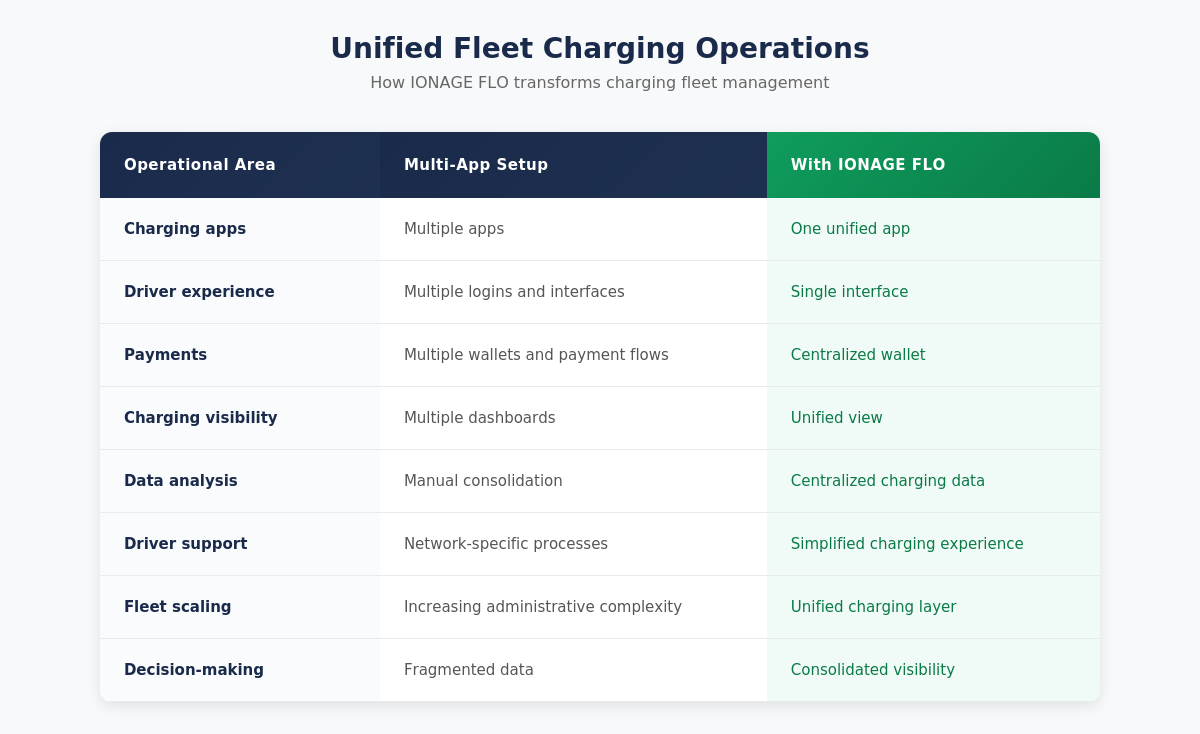
The difference isn't just fewer apps.
It's less operational friction.
A Simple Example: 100 Vehicles Across 3 Cities
Consider a fleet operating 100 EVs across three cities and using five different charging networks.
Without a unified charging platform:
The operations team has to manage multiple applications and dashboards.
Drivers need to understand different charging processes.
Finance has to reconcile transactions from different networks.
Charging data is spread across platforms.
Identifying cost and utilization patterns requires manual analysis.
As the fleet grows, the workload grows with it.
With FLO:
Drivers have a single charging interface.
Operations gets a more consolidated view of charging activity.
Charging access becomes simpler across supported networks.
Finance gets a more centralized view of charging transactions.
And the operations team can spend more time answering the important questions:
Where are we spending?
Why are we spending it?
Where are we losing time?
How can we improve utilization?
That's the difference between managing charging and optimizing charging.
The Bottom Line
Multiple charging apps may seem like a small inconvenience.
For a fleet, they're not.
Every additional app introduces another login.
Another wallet introduces another reconciliation task.
Another dashboard introduces another source of fragmented data.
Another charging workflow creates another opportunity for driver friction.
Individually, these problems may seem small.
Together, they create an operational drag that becomes increasingly expensive as your fleet grows.
The answer isn't to wait for the charging ecosystem to become simpler.
It's to build a simpler layer on top of the complexity that already exists.
IONAGE FLO brings multiple charging networks together through one fleet-focused platform, helping operators simplify charging access, centralize visibility, and spend less time managing fragmented charging infrastructure.
Because your fleet has enough things to manage.
Charging apps shouldn't be one of them.
One app. One wallet. Multiple charging networks.
That's IONAGE FLO.
FAQs
Do we have to stop using our existing charging networks?
No. FLO is designed to help fleet operators access multiple charging networks through a unified experience rather than managing each network through a separate app.
Do drivers need to use multiple apps?
FLO is designed to simplify the driver experience by providing a single interface for supported charging networks.
Can we see charging activity across different networks?
FLO provides fleet operators with a more consolidated view of charging activity across supported networks, helping teams monitor usage and identify operational patterns.
Does FLO work for large fleets?
Yes. FLO is designed for fleet operators and can support fleets as they scale across vehicles, routes, cities, and charging networks.
How does FLO help reduce charging administration?
By bringing charging access, payment, and visibility into a unified platform, FLO reduces the need for teams and drivers to manage multiple charging applications separately.
Ready to Simplify Fleet Charging?
Stop switching between charging apps.
Start managing your charging operation as one system.
Book a demo of IONAGE FLO and see how a unified charging experience can simplify your fleet operations.
IONAGE FLO
One app. One wallet. Multiple charging networks.
As the world shifts gears toward a more sustainable future, the way we drive is changing—fast. Are you in the market for an EV? In your research, you might have come across different EV and Hybrid technologies from various manufacturers. Was it confusing or complex? We are here to de-mystify and help in your decision.
No worries—we’re here to break it down! Let’s explore the key differences between Electric Vehicles (EVs) and Hybrid Vehicles, so you can make the right choice.
What is the deal with electric vehicles (EV’s)
Electric vehicles run purely on electricity and are powered by rechargeable batteries that run the electric motor. That’s it. Here are a few reasons that give EVs an unfair advantage:
- Modern Design and Ownership: EVs have changed the fundamentals of the vehicle. You see a much more modern aesthetic and design for EVs. Additionally, this helps EV manufacturers develop innovative ways of ownership such as the MG Windsor.
- Lower Running Costs: The charge per kilometer for EVs is much lower than running on gas. Also, fewer running parts mean lesser maintenance.
- Eco-Friendly: With zero emissions, EVs are cleaner and quieter than traditional cars, contributing to reduced pollution and better air quality. Good for the planet, good for your lungs!
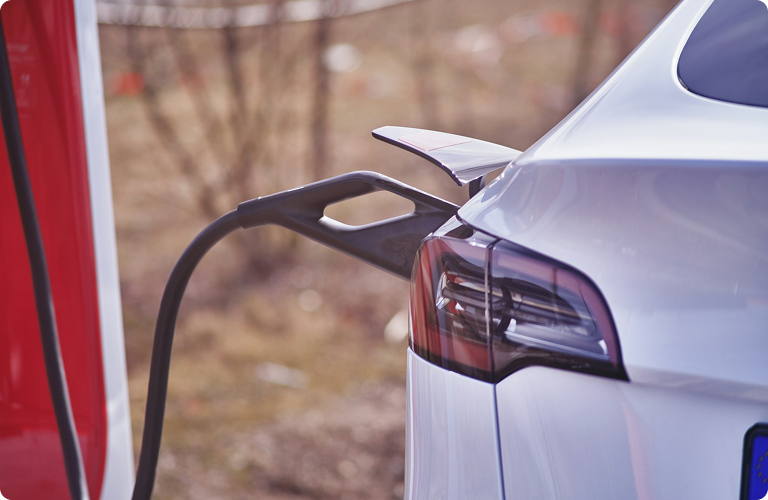
But it’s not all sunshine and supercharging. EVs do have some limits, especially when it comes to range. Currently, You’ll need to plan ahead if you’re going on a long road trip, but hey—that’s what apps and fast chargers are for! Then there is the question of batteries.
The Hybrid Vehicle: Best of Both Worlds?
If you're not ready to go fully electric yet, the next available option is a hybrid Vehicle. A hybrid vehicle uses a combination of gasoline and electric power to drive the vehicle. Hybrid technologies are considered a great intermediate step before the grand march toward a fully EV world. This makes them easy to recommend.
Here’s why a Hybrid Vehicle might be considered:
- Better Fuel Efficiency: Since hybrids can use electricity to supplement gasoline, they use less fuel overall—making them more efficient than traditional gas-powered cars.
- Extended Range: Worried about running out of charge? Hybrids still have gasoline backup, so you can go the distance without range anxiety.
- Familiarity: between EV and ICE, Hybrids feel like traditional fuel-powered cars but add a sustainable twist. It's just like an extension of an ICE.
Before pegging on the Hybrid Vehicle, consider the following.
- Space and Design: Hybrid Vehicles need to have batteries as well as a combustion engine. This greatly reduces space efficiency. Big boxes for the next adventure would be difficult to fit. They are also not as quiet as EVs. The design tends to be closer to traditional automotive without the advantages of the modern EV experience.
- Extended Range: Worried about running out of charge? Hybrids still have gasoline backup, so you can go the distance without range anxiety.
- Familiarity: between EV and ICE, Hybrids feel like traditional fuel-powered cars but add a sustainable twist. It's just like an extension of an ICE.
Still, for those who aren’t ready to take the full EV plunge, hybrids offer a solid first step.
Which One Should You Choose?
Ultimately, deciding between an EV and a Hybrid Vehicle comes down to your lifestyle and driving needs.
- If you’re all about cutting emissions and want the latest tech with the lowest environmental impact, go electric. You’ll be doing your part to keep the planet green while enjoying cutting-edge innovation.
- If you’re not ready to give up the flexibility of gasoline but still want to reduce your carbon footprint, a hybrid might be the perfect compromise.
At Ionage Technologies, we believe in the power of choice—because there’s no one-size-fits-all answer when it comes to sustainable driving. Whether you choose a full EV or a hybrid, both options represent a step toward a cleaner, smarter future.
Wrapping it up: the road ahead
As EV charging infrastructure grows and technology improves, the gap between electric and hybrid vehicles is closing fast. More people are embracing electric mobility, and the future looks bright. Whichever path you choose, it’s clear that sustainable mobility is the destination.
Ready to make your move? Join us on the journey to electrify the roads and drive toward a greener tomorrow.