In This Blog
Get tips, updates & exclusives—no spam


BLOGS
Why EV Trip Planners Fail in the Real World (And What EV Drivers Actually Need)
Ev Trip Planning
.png)
Why EV Trip Planners Fail in the Real World (And What EV Drivers Actually Need)
Electric vehicles have evolved rapidly. Battery range has improved. Charging infrastructure is expanding. Trip planning tools are becoming more sophisticated.
On paper, long EV journeys should feel effortless.
Open an app. Enter your destination. Follow the route. Charge when prompted. Reach comfortably.
But if you’ve actually driven an EV on a long highway route, you know the truth:
EV trip planning still feels more stressful than it should.
And it’s not because of range.
It’s because trip planners are built on technical assumptions, while drivers make decisions based on human instinct.
The Gap Between Planning and Reality
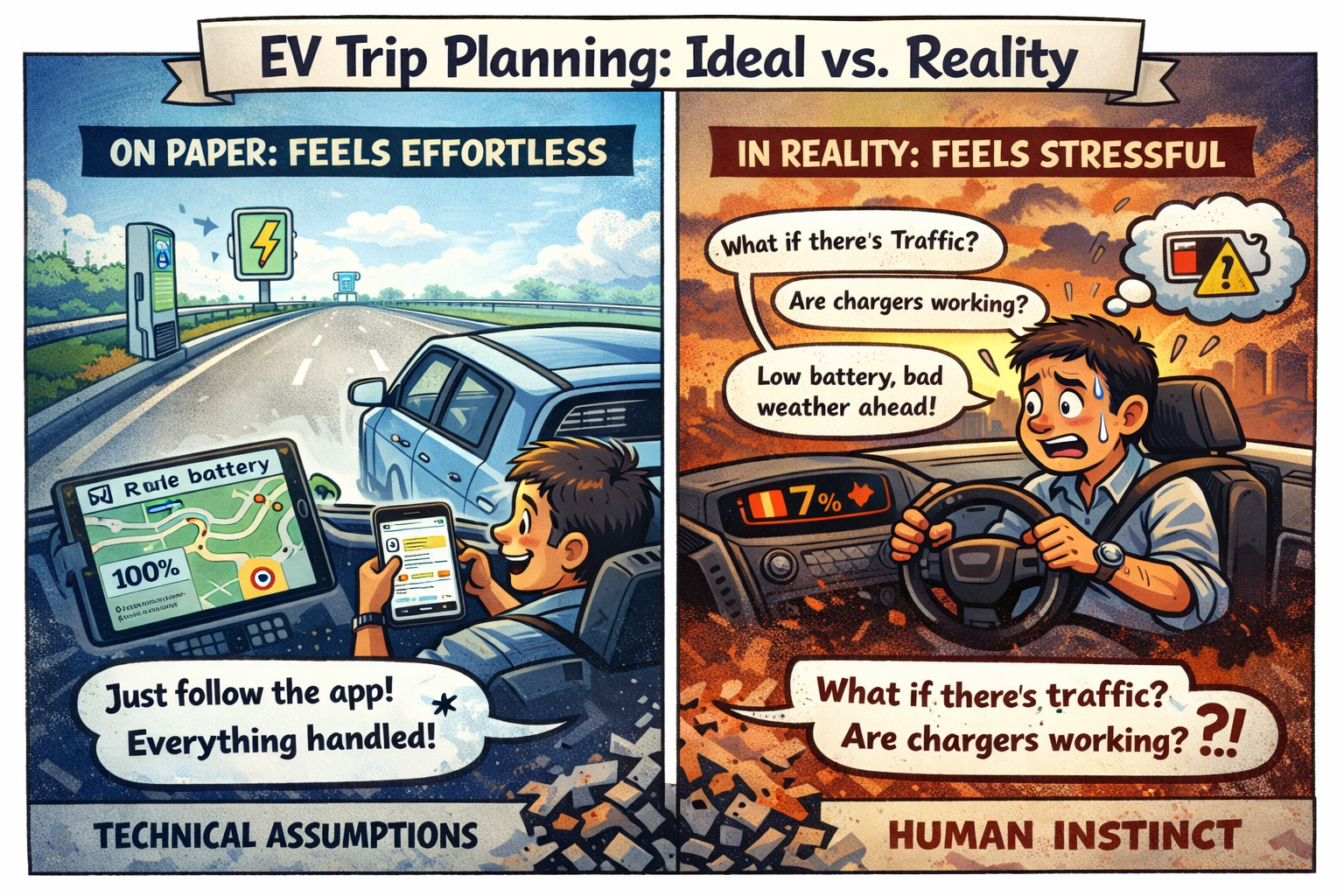
Most EV trip planners today operate on a simple formula: battery percentage + distance + charger locations.
Technically, this is correct.
But driving an EV isn’t just a technical exercise. It’s an emotional one.
When a planner tells you that you will arrive at a charging station with 7% battery remaining, the algorithm sees efficiency.
The driver sees risk.
No one willingly drives into a charger with single-digit battery unless absolutely necessary. Most drivers have a personal comfort threshold, often 30% or even 40%, below which anxiety begins to creep in.
That’s the first disconnect.
Trip planners optimise for minimum charging time. Drivers optimise for maximum peace of mind.
Why Drivers Don’t Follow Trip Plans End-to-End
Interestingly, most EV users do use trip planners, but only partially.
They open the app to:
- Check if chargers exist on their route
- See where major charging clusters are
- Verify live availability before arrival
What they rarely do is follow the suggested plan step-by-step.
If the planner says, “Skip this charger and go 80 km ahead,” many drivers won’t.
If the app suggests charging from 18% to 80% and leaving, most drivers will continue charging to 95% or even 100%.
Why?
Because real-world infrastructure is not perfectly predictable.
A charger might show “available” but could go offline.
It could be occupied by the time you arrive.
It might charge slower than expected.
So drivers build buffers.
They charge earlier than necessary.
They charge longer than recommended.
They keep backup options in mind.
Not because they don’t understand efficiency, but because they understand uncertainty.
Charging Is a Human Decision, Not Just a Battery Decision
Another reason EV trip planning feels disconnected from reality is that it assumes charging stops are purely technical.
In real life, they’re not.
People stop when:
- It’s lunch time
- They want tea or coffee
- Children need a restroom break
- They feel fatigued
Charging simply attaches itself to these moments.
If a planner suggests stopping at 11:10 AM for 24 minutes because the battery calculation demands it, but the driver wants to stop at 1 PM for lunch, the plan is already broken.
A well-designed EV trip planner must understand that charging aligns with human rhythms, not just battery curves.
The Trust Problem in EV Route Planning
Trust is the biggest missing variable in EV trip planning.
Drivers don’t just choose chargers based on proximity. They consider:
- Brand familiarity
- Location visibility
- Past experiences
- Reviews
- Perceived safety
A suggested charger in an isolated area may be skipped, even if technically optimal.
A known charger at a busy food plaza may be preferred, even if it adds distance.
Trip planners today rarely account for these behavioural preferences.
And because they don’t, drivers override them.
Why Precision Doesn’t Always Feel Reassuring
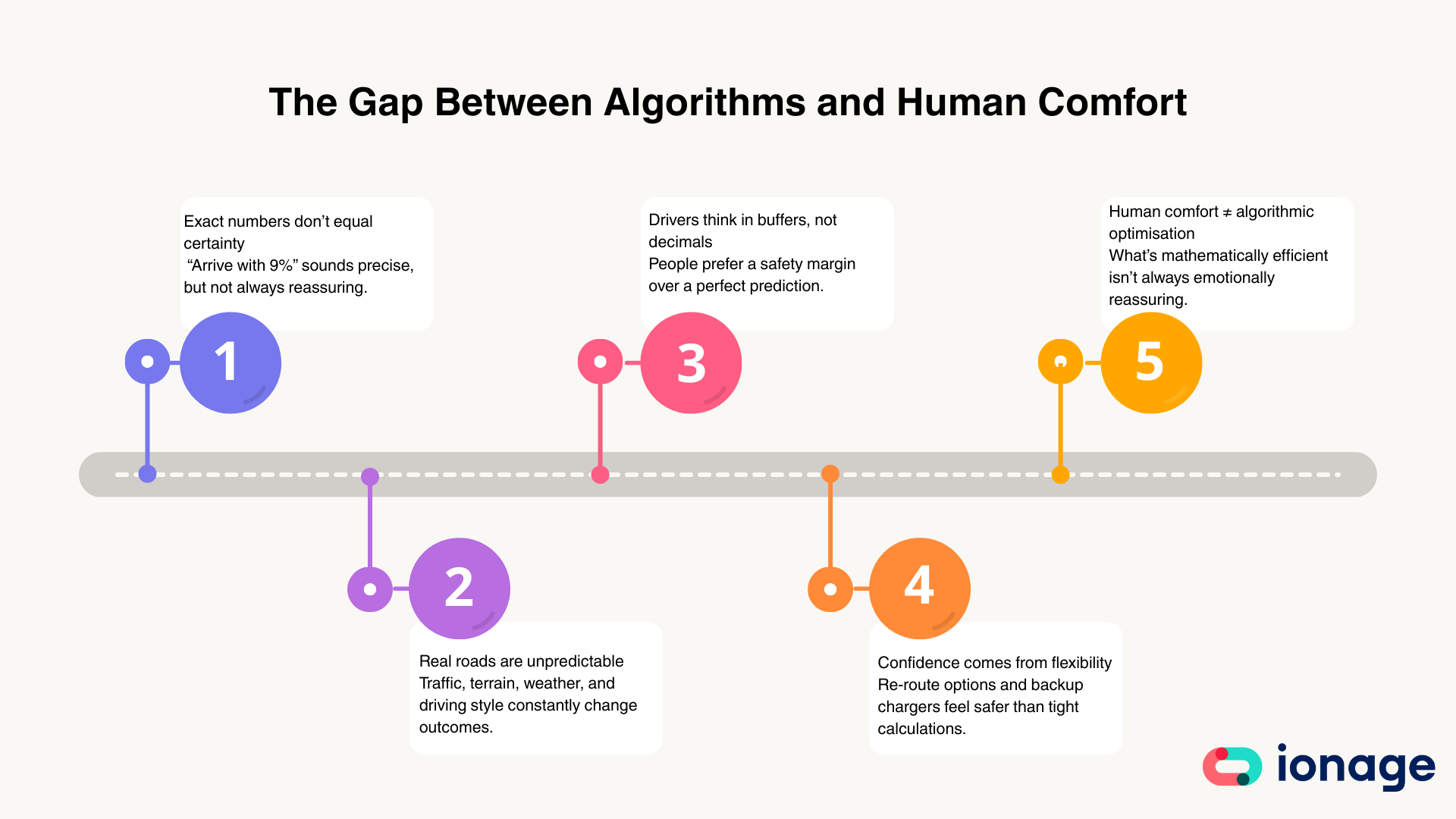
Modern EV trip planners pride themselves on precise predictions:
“You will arrive with 9% battery.”
“Charging for 22 minutes is sufficient.”
But real-world driving conditions change constantly:
- Traffic congestion
- Elevation shifts
- Weather conditions
- AC usage
- Driving speed
Drivers intuitively know that numbers can shift.
So instead of trusting exact arrival percentages, they create margins.
They plan for uncertainty, not perfection.
And that’s a fundamental difference between algorithmic optimisation and human comfort.
The Fragility of Current Trip Planning
Perhaps the biggest issue with EV trip planning today is fragility.
If one suggested charger fails, the entire route feels compromised.
There is no psychological safety net built into many planning systems.
So drivers compensate manually.
They scan alternative chargers ahead of time.
They memorise backup locations.
They overcharge to avoid dependency on a single stop.
In reality, most EV drivers are running parallel plans in their heads, even while using a trip planner.
That alone tells us something important.
EV Trips Don’t Fail Because of Range
The EV industry often frames long-distance travel anxiety as a range problem.
But in many cases, it’s not about battery capacity.
It’s about confidence.
Drivers feel stressed not because their EV can’t make the journey, but because planning tools don’t fully reflect real-world behaviour and infrastructure unpredictability.
EV trip planning needs to move from being battery-first to behaviour-first.
It needs to ask:
- What is your minimum comfort battery level?
- How often do you prefer to stop?
- Do you prioritise familiarity over optimisation?
- Do you want backup chargers visible at every stage?
When trip planning adapts to human psychology, not just vehicle efficiency, stress naturally reduces.
Making EV Trip Planning Less Stressful
EV trip planning should not feel like a gamble.
It should feel structured, predictable, and built around how people actually drive, with flexibility in charging decisions, visibility into reliable infrastructure, and the confidence that backup options are always within reach.
At IONAGE, we understand that EV journeys are not just about battery percentages and distance calculations. They’re about trust, trust in the charger, trust in availability, and trust in the plan.
That’s why IONAGE focuses on helping drivers discover verified charging stations, check live availability, and make informed decisions on the road. Instead of rigid optimisation, the goal is clarity and control, so you charge when you’re comfortable, not when an algorithm forces you to.
EV journeys shouldn’t feel like risk management exercises.
They should feel planned, supported, and fully under control.
And that’s the experience IONAGE is built to deliver.
As the world shifts gears toward a more sustainable future, the way we drive is changing—fast. Are you in the market for an EV? In your research, you might have come across different EV and Hybrid technologies from various manufacturers. Was it confusing or complex? We are here to de-mystify and help in your decision.
No worries—we’re here to break it down! Let’s explore the key differences between Electric Vehicles (EVs) and Hybrid Vehicles, so you can make the right choice.
What is the deal with electric vehicles (EV’s)
Electric vehicles run purely on electricity and are powered by rechargeable batteries that run the electric motor. That’s it. Here are a few reasons that give EVs an unfair advantage:
- Modern Design and Ownership: EVs have changed the fundamentals of the vehicle. You see a much more modern aesthetic and design for EVs. Additionally, this helps EV manufacturers develop innovative ways of ownership such as the MG Windsor.
- Lower Running Costs: The charge per kilometer for EVs is much lower than running on gas. Also, fewer running parts mean lesser maintenance.
- Eco-Friendly: With zero emissions, EVs are cleaner and quieter than traditional cars, contributing to reduced pollution and better air quality. Good for the planet, good for your lungs!
But it’s not all sunshine and supercharging. EVs do have some limits, especially when it comes to range. Currently, You’ll need to plan ahead if you’re going on a long road trip, but hey—that’s what apps and fast chargers are for! Then there is the question of batteries.
The Hybrid Vehicle: Best of Both Worlds?
If you're not ready to go fully electric yet, the next available option is a hybrid Vehicle. A hybrid vehicle uses a combination of gasoline and electric power to drive the vehicle. Hybrid technologies are considered a great intermediate step before the grand march toward a fully EV world. This makes them easy to recommend.
Here’s why a Hybrid Vehicle might be considered:
- Better Fuel Efficiency: Since hybrids can use electricity to supplement gasoline, they use less fuel overall—making them more efficient than traditional gas-powered cars.
- Extended Range: Worried about running out of charge? Hybrids still have gasoline backup, so you can go the distance without range anxiety.
- Familiarity: between EV and ICE, Hybrids feel like traditional fuel-powered cars but add a sustainable twist. It's just like an extension of an ICE.
Before pegging on the Hybrid Vehicle, consider the following.
- Space and Design: Hybrid Vehicles need to have batteries as well as a combustion engine. This greatly reduces space efficiency. Big boxes for the next adventure would be difficult to fit. They are also not as quiet as EVs. The design tends to be closer to traditional automotive without the advantages of the modern EV experience.
- Extended Range: Worried about running out of charge? Hybrids still have gasoline backup, so you can go the distance without range anxiety.
- Familiarity: between EV and ICE, Hybrids feel like traditional fuel-powered cars but add a sustainable twist. It's just like an extension of an ICE.
Still, for those who aren’t ready to take the full EV plunge, hybrids offer a solid first step.
Which One Should You Choose?
Ultimately, deciding between an EV and a Hybrid Vehicle comes down to your lifestyle and driving needs.
- If you’re all about cutting emissions and want the latest tech with the lowest environmental impact, go electric. You’ll be doing your part to keep the planet green while enjoying cutting-edge innovation.
- If you’re not ready to give up the flexibility of gasoline but still want to reduce your carbon footprint, a hybrid might be the perfect compromise.
At Ionage Technologies, we believe in the power of choice—because there’s no one-size-fits-all answer when it comes to sustainable driving. Whether you choose a full EV or a hybrid, both options represent a step toward a cleaner, smarter future.
Wrapping it up: the road ahead
As EV charging infrastructure grows and technology improves, the gap between electric and hybrid vehicles is closing fast. More people are embracing electric mobility, and the future looks bright. Whichever path you choose, it’s clear that sustainable mobility is the destination.
Ready to make your move? Join us on the journey to electrify the roads and drive toward a greener tomorrow.